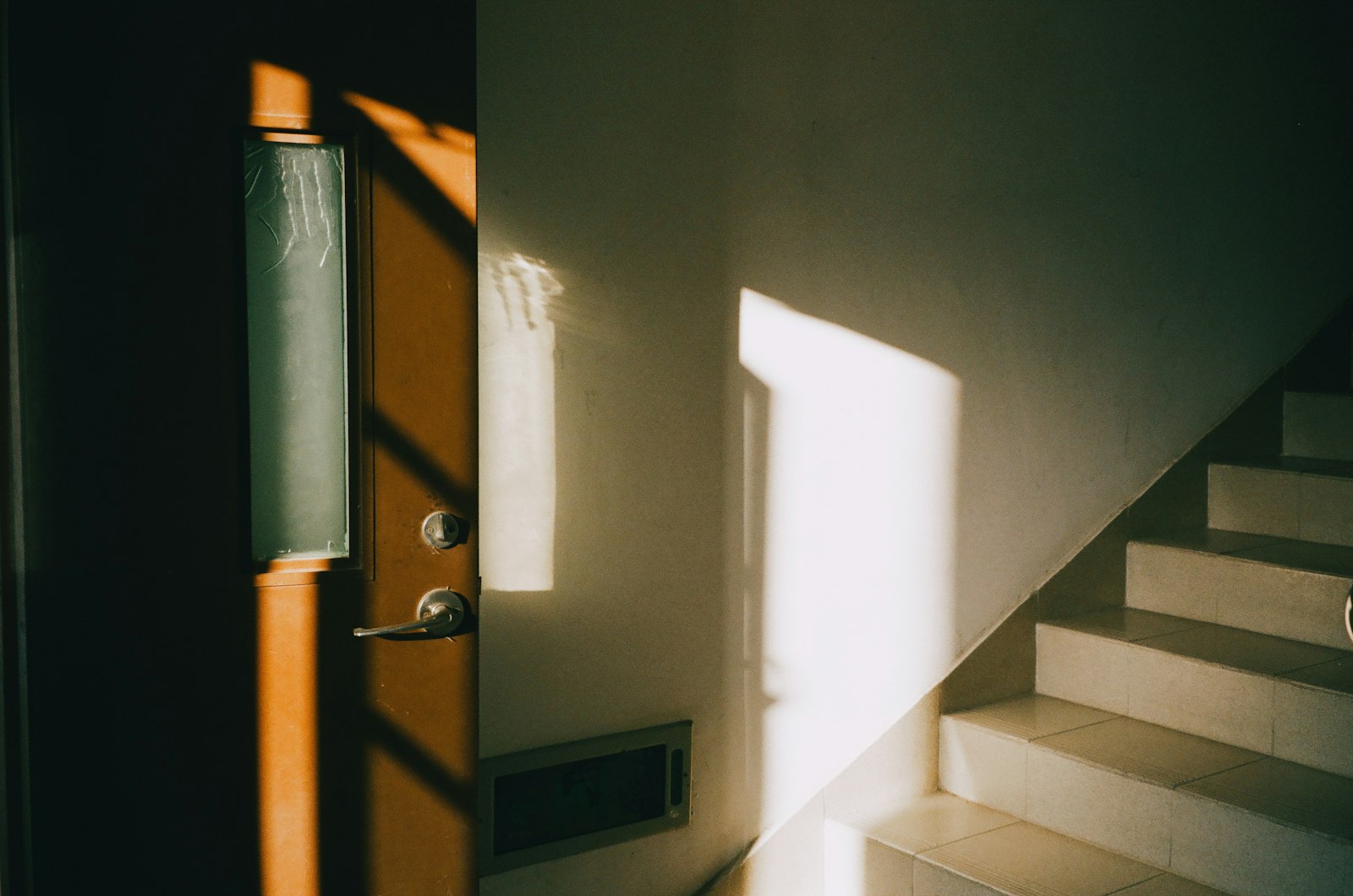
The middle of a staircase at night is the one place in a house where
your own shadow can put you in the hospital. You climb with a light
behind you at the bottom, and every step projects your body forward onto
the treads you are about to hit: the shadow moves when you move, darkens
exactly where you need to see, and the brighter the single fixture
behind you, the sharper the shadow gets. That is the counterintuitive
spec of stair lighting: the problem is almost never brightness. It is
contrast, and the direction the light travels relative to the person on
the stairs. Every fall on a staircase happens during a transition, top
step to bottom step, and the lighting either marks that transition or
hides it.
The real problem: contrast, not lumens
A stairway is read by the eye as a rhythm of nosing lines, the front
edge of each tread catching light while the riser stays dark. When that
rhythm is even, you place your feet without thinking. When one tread is
lit and the next is not, when glare washes the nosings flat, or when a
shadow lies across the middle of the run, the rhythm breaks and the foot
starts guessing. Vision research on stair safety keeps landing on the
same variables: tread-edge contrast and how evenly the treads are lit,
with the direction of light close behind. Lumens on a package say
nothing about any of these.
This is also why the common fix, a single bright fixture on the ceiling
over the stairwell, performs so badly in practice. It lights the upper
treads from a steep angle, throws the lower run into shadow behind the
body of anyone descending, and puts a glare source directly in the
eyeline of a person climbing. On paper it solves the room. In practice
it lights a ceiling.
Where the light goes
Three layers cover a staircase, and the order matters because each one
changes what the next has to do.
Ambient: light the whole run, not the ceiling. The goal is even
illumination across every tread, which in most homes means two smaller
sources instead of one big one: a fixture at the top landing and one at
the bottom, or wall sconces distributed along the stair wall. Mount
sconces high enough that nobody on the stairs looks into the lamp,
around 66 to 72 inches above the tread at that point, and space them so
no stretch of the run goes more than about 6 feet without a source. The
target on the treads is modest, roughly 100 to 200 lux measured flat on
the walking surface; code requires at least a footcandle, about 11 lux,
at the center of each tread for egress stairs, and any working fixture
clears that. Uniformity is the number that separates a safe staircase
from a technically lit one.
Task: mark the nosings. Low-mounted step lights, recessed into the
riser or tucked under each nosing, put a small pool of light across the
front edge of the tread below it. This is the layer that does the actual
safety work, because it builds the light-dark rhythm the eye reads as a
staircase, and it keeps working when the general lights are off. LED
step lights draw a few watts, which is what makes the next layer
possible.
Night lighting: always on, barely noticed. The most dangerous trip
on a staircase happens at 2 a.m., when nobody is going to switch on a
three-lamp array. Step lights or a low-output strip along the base of
the stair wall, on a motion sensor or a dim overnight setting, give the
eye just enough rhythm to place its feet. Warm 2700K keeps it from
reading as hospital corridor, and the whole run can cost less than a
nightlight to run.
Switching: two entrances, two controls
A staircase is the only room in the house with a mandatory door at both
ends, and it is wired like one or it fails like one. The standard
answer, and it is the right one, is three-way switches at the top and
bottom so the light can be turned on from wherever you are and off when
you leave. Long runs with intermediate landings take a four-way in the
middle. Every one of these is ordinary wiring during a renovation and
disproportionately annoying to retrofit after.
When rewiring is not happening, two honest substitutes exist. A motion
sensor at each end controls a fixture without any new conductors, and
smart bulbs with a physical keypad at top and bottom replicate three-way
behavior without pulling wire. What does not work is the pull chain, the
single switch at the bottom, or any scheme that requires someone to
climb in the dark or leave a light burning until morning. Stair lights
left on all day are not a habit problem; they are a wiring problem
showing itself.
The bulb spec nobody checks
Color temperature barely matters on a staircase and CRI matters not at
all; nobody is matching navy socks at the landing. The spec that
matters is flicker at low output. Step lights and night-running strips
run at low drive levels where the cheapest LED drivers flicker visibly,
and a flickering light at the edge of your vision on a dark staircase
does the opposite of its job: it pulls attention off the treads. This is
the same failure covered in our dimmer
guide, where load and driver quality
decide whether an LED holds steady at the bottom of its range, and the
picking logic transfers directly: named driver, documented low-output
behavior, and a price that reflects one of those two things.
Common mistakes
- One ceiling fixture over the well. It glares at climbers and
shadows the run for anyone coming down. Two smaller sources beat one
big one on stairs, everywhere else in the house it is the reverse.
- Switch at one end only. The top or the bottom of the stairs,
whichever lacks the switch, becomes a dark-zone entrance every single
night. Three-way wiring is the fix, motion sensing is the workaround.
- Lights mounted where the body blocks them. A sconce at shoulder
height behind a descending person casts the person across the treads.
High sconces or low step lights keep the light out of the shadow
business.
- Bright, cool light because stairs feel utilitarian. A 5000K
stairwell reads as a fire escape at 11 p.m., and glare from a cold
source flattens the nosing contrast the light was installed to create.
2700K to 3000K, shielded.
- Skipping the night layer. The general lights solve the staircase
at 7 p.m.; the falls happen at 2 a.m. A few watts of always-available
step lighting is the cheapest safety equipment in the house.
The staircase is the fourth stop in the Room by Room series, after the
hallway, the home
office, and the
closet, and it is the least
forgiving: no other room punishes a bad layout physically. Light the
run evenly from two ends, mark the nosings low, wire both entrances,
and leave a whisper of light on overnight. Do those four and the
staircase stops being the statistic it currently is.