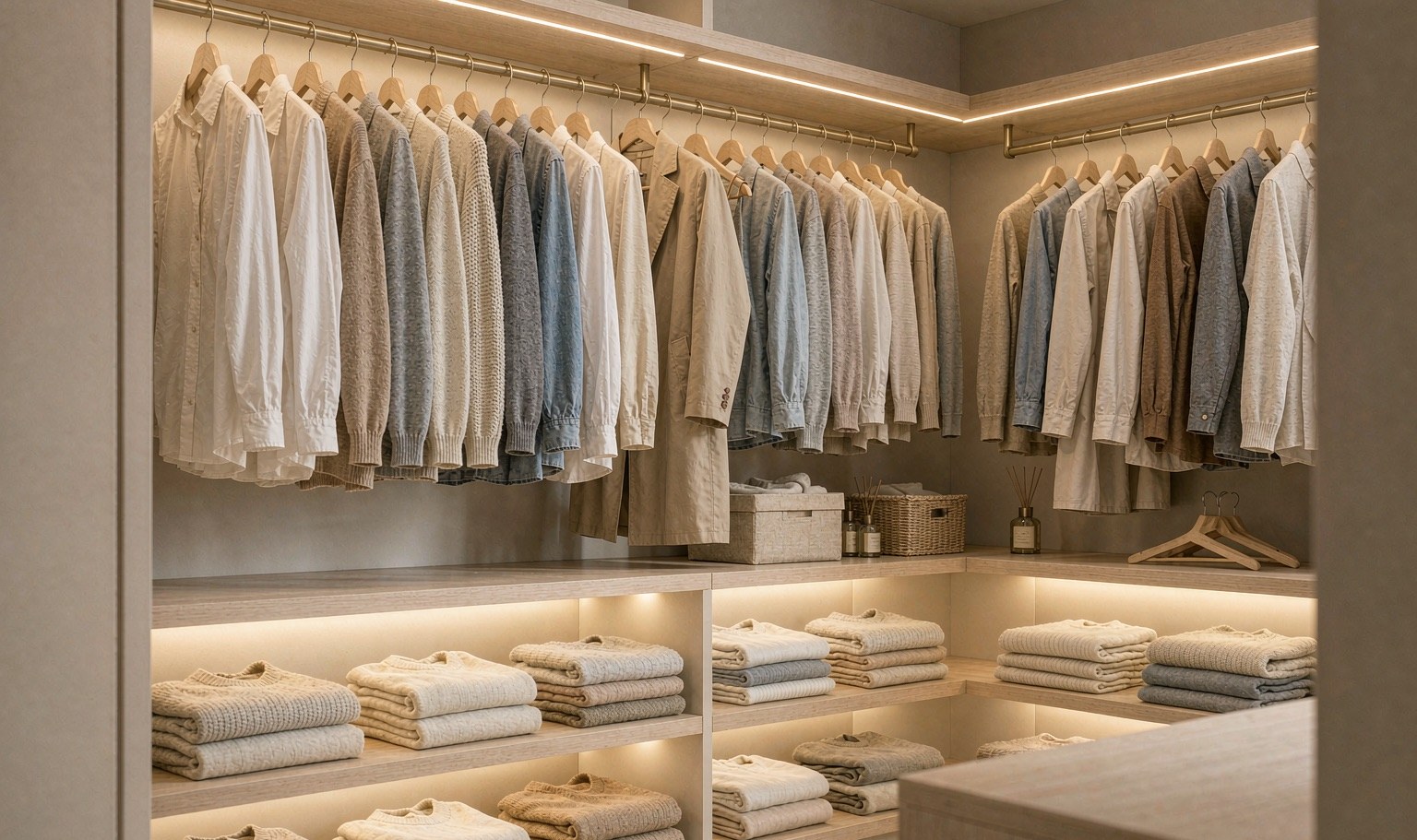
The navy-black test happens around 7 a.m., in a closet lit by whatever
the bedroom spills through the open door. Two shirts come off the rack,
they looked identical in the store under honest light, and one of them is
not the color you thought it was. Here is the part that surprises people:
brightness is almost never the reason. A closet can be brightly lit and
still fail the navy-black test, because the two specs that decide whether
fabric color reads true are the ones nobody checks on the box.
The two real problems: color and shadow angle
Closet lighting fails in exactly two ways, and neither is fixed by a
brighter bulb. The first is color rendering: the light source flattens
the difference between similar dark colors. The second is geometry: the
light arrives from behind the person reaching for the clothes, so the
closet's brightest object is the user's own shadow, cast across the rack.
Both are spec problems with spec answers, which is why closets are one of
the few places in a house where the lighting order of operations is
genuinely simple: pick the light quality, then place the fixtures so the
shadows fall where nobody stands.
Color temperature: bridge to the bedroom
A closet usually opens into a bedroom, and the two spaces read as one
continuous view. That constrains the choice. If the bedroom runs warm
2700K bulbs, a 5000K closet looks like a laboratory annex and the doorway
becomes a color jump every time you pass through it. Guidance based on
IES recommended practice puts closets and dressing areas in the 3000K to
3500K range, which renders fabric color more cleanly than 2700K while
still reading as home rather than showroom. The logic behind that range
is the same one covered in our color temperature
guide: lower Kelvin numbers warm the
light but also shift every color they touch, and dark navy fabric under
heavy warm light loses the cool undertone that separates it from black.
The defensible pick: 3000K if the bedroom is warm, 3500K if the bedroom
already runs neutral. Anything above 4000K in a dressing space is a
choice for storage warehouses, not for rooms where people look at
themselves.
CRI: the spec that actually matters
Color Rendering Index measures how faithfully a light source shows color
compared to a reference source, on a 0 to 100 scale. Most consumer LED
bulbs and strips sit at CRI 80, which is fine for hallways and adequate
for kitchens and genuinely wrong for closets, because the colors you
discriminate between in a closet are small, dark, and adjacent: navy
against black, charcoal against brown, forest against grey. Industry
specification practice treats CRI 90 as the threshold for accurate color
judgment, and LED strip and bulb lines with CRI 90+ carry only a modest
premium over standard stock. This is the rare upgrade where the numbers
and the price both argue the same way. The spec that matters, printed
smaller than the lumens on every package: look for CRI 90 or higher, or
the R9 value if a datasheet is available, and treat anything unlisted as
CRI 80.
Where the light goes: strips, shelves, and the shadow angle
Placement decides whether the best strip in the world works. Two
locations cover a closet, and they fail differently.
Shelf front edge. LED strip along the underside front edge of each
shelf, facing down and slightly back, washes the shelf contents below it
in even light. Mounted at the front edge, it puts light on the folded
stacks; mounted at the back or center of the shelf underside, it leaves
the front row of items in shadow thrown by the row behind them. The
front edge is where the shadow angle gets solved.
Hanging rod. The instinct is to run strip behind the rod, tight to
the wall, where it looks tidy. That position guarantees the classic
failure: every hanger blocks its own light and your body blocks the
rest. The strip belongs just in front of the rod, on the ceiling or on a
small bracket, so light falls across the front faces of the hanging
clothes rather than down their backs. If the closet is deep, a second
run closer to the door handles the reach-in zone where nobody stands
inside.
For the shelf strips themselves, the wiring and output logic is the same
one behind under-cabinet kitchen
lighting, and it transfers
directly: short runs, front-edge mounting, diffused lens over bare diodes
so each LED does not print itself onto a folded white shirt.
Switching: make it automatic
A closet light you have to think about is a closet light you will leave
on, and closet fixtures sit inches from stored fabric, which makes
forgetfulness a worse trade than in most rooms. Door-contact switching
solves it: a small magnetic reed switch on the frame trips the light when
the door opens and kills it when the door closes, with no new wall
controls and no habits to build. On sliding doors, a swing-door sensor
works poorly and a motion sensor inside the closet works better, since
the tracking path of a slider does not hold a magnet in one place.
Battery and USB-rechargeable stick-on strips occupy the bottom of the
budget, and they are honest about it: output fades as the battery does,
and CRI on the cheapest units is unlisted for a reason. They work for a
linen closet. For a closet where you dress every morning, wired or
plugin strips with door-triggered switching hold their output, and that
stability is the point.
The code footnote nobody expects
In the US, hard-wired closet lighting has rules, and they surprise people
who assumed a closet is just a small room. The National Electrical Code,
in Section 410.16, restricts fixture types in clothes closets entirely on
fire grounds: surface-mounted incandescent and LED fixtures with
completely enclosed light sources must sit at least 12 inches from the
defined storage space, recessed enclosed fixtures at least 6 inches, and
pendants, bare lampholders, and open or partially enclosed lamps are
prohibited outright. The storage space itself is defined generously,
extending 24 inches from the walls up to the highest rod or 6 feet.
Battery-powered strips sidestep all of this, which is part of why they
are popular; any wired fixture in a closet should be checked against the
code section, and anything at ceiling height over a shelf is exactly
where the 12-inch rule bites.
Common mistakes
- Buying lumens instead of CRI. A 1000-lumen CRI-80 strip shows you
less usable color than a 500-lumen CRI-90 strip. In a closet, the
second number is the spec.
- Strip behind the rod. Tidy looking, functionally backwards: the
rod shadows everything it was installed to light.
- One ceiling fixture for a reach-in. It lights the top shelf and
the hanger shoulders and nothing else. Shelves need their own wash;
the ceiling fixture only earns its keep in a walk-in.
- Mixing temperatures with the bedroom. A 4000K closet off a 2700K
bedroom makes both spaces look wrong, each used as the reference for
the other.
- Ignoring the door. Manual switches in closets fail by being left
on; a door sensor is a ten-dollar part that removes the failure mode
entirely.
The closet is the smallest room in the Room by Room series so far, after
the hallway and the home
office, and the easiest to get
right: CRI 90, 3000K, strips at shelf front edges and in front of the
rod, triggered by the door. Four decisions, made once, and the
navy-black test stops being a gamble.