A hallway is the one room in the house nobody chooses to be in, which is
exactly why it loses the lighting argument every time. The result is the
same in thousands of homes: one sad center fixture, a dim run of doors, and
a light switch you reach for at full brightness because anything lower
means navigating by sonar. Hallway lighting done well costs little — it is
a spacing problem and a layering problem, not a budget problem.
Ambient first: spacing beats brightness
The instinct is to buy a brighter bulb. The real fix is distribution: light
every eight feet beats one fixture every sixteen feet at twice the output.
On a standard 8-foot ceiling, place ceiling fixtures roughly 8 feet apart,
and offset them from the hallway centerline — a few inches either side — so
the pools overlap instead of leaving scalloped shadows. Flush or
semi-flush mount fixtures suit most halls; a low ceiling and a hanging
pendant are a conflict (the height math for pendants is its own subject,
covered in our pendant height guide).
Long runs take the same rule scaled up. A twenty-foot hallway wants
three fixtures, not two, because two sources at the ends leave the
middle to fend for itself; a twelve-foot run gets away with two. When
the hallway doubles as the route to a bathroom used at night, the
spacing matters doubly, since anyone walking it at 3 a.m. is doing so
half-asleep and the dark patches between pools are where stubbed toes
happen.
Sconces: the hallway's best fixture
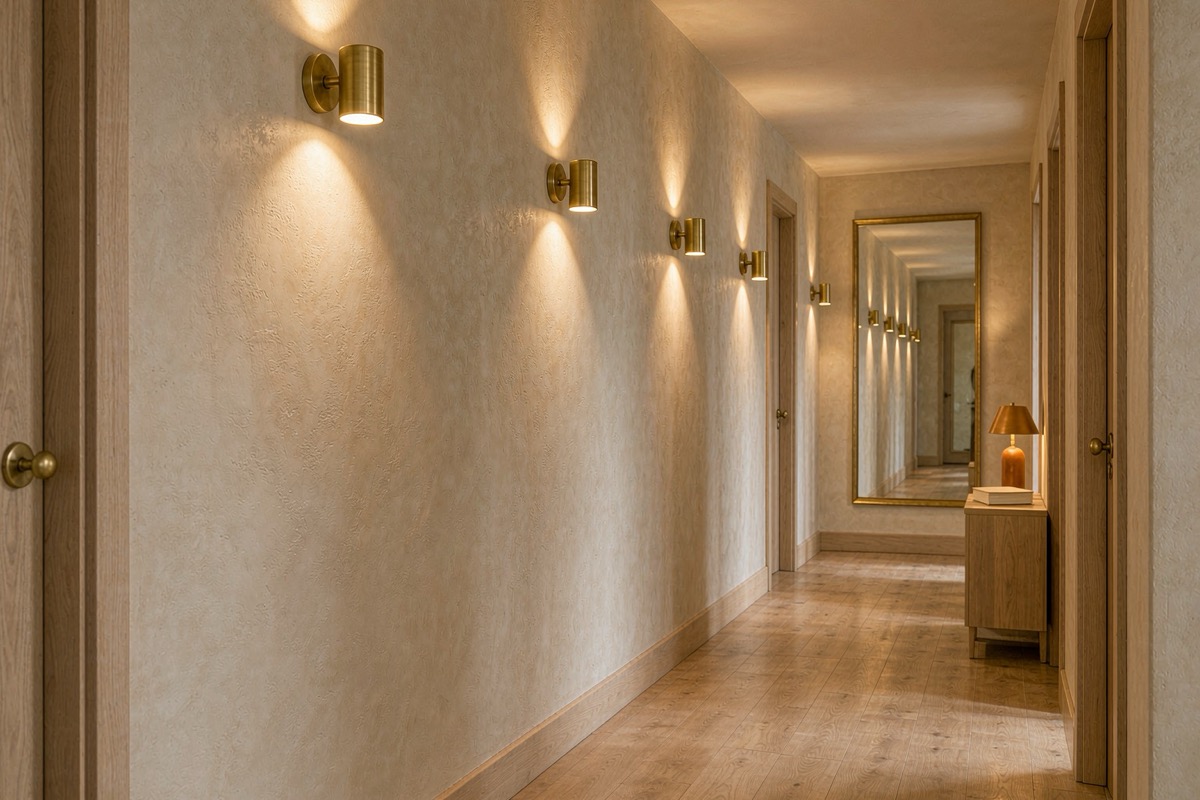
Wall sconces earn their keep in corridors more than anywhere else — they
narrow light into the plane your eye actually reads, and they free floor
space. Mount them 60 to 66 inches to center, and where the run is long,
about 6 to 8 feet apart. The beauty of hallways specifically is that
rewiring is often avoidable: plug-in wall
sconces with a cord cover turn a dark
rental corridor into a lit one in an afternoon, no electrician, no opened
walls. For the entry end of the hall, exterior-adjacent choices follow the
same logic we laid out in the outdoor wall lights
guide — glare control matters, and
warm 2700K reads welcoming from the door.
Stairs and turns get their own light
Any stair, threshold or direction change needs its own fixture. A
shadowed step is a fall waiting to happen, and falls on stairs are
exactly the kind of household accident that lighting prevents for the
cost of a bulb. Treat this as a safety install, not decoration: a small
low-level light at the turn, or a fixture aimed at the treads rather
than the wall above them, does more for the hallway than any new
chandelier would.
The switching matters as much as the fixture. A staircase you use after
dark wants a switch at both ends, so nobody climbs toward a light they
just turned off. Plug-in night lights on a stair landing cost almost
nothing and cover the descent without waking the whole floor. If the
hall turns a corner mid-run, that corner is its own lighting zone: one
fixture per direction of travel, or the turn reads as a dead end no
matter how bright the straight sections are.
Accent light that pulls the eye down the run
Ambient and sconces cover most halls, but accents separate a lit
corridor from a considered one. A picture light over a frame, or a slim
LED strip above shelving, gives the eye a reason to travel the length of
the hall — and an eye that travels sees the space as longer and less
tunnel-like. Keep accent fixtures warmer and dimmer than the ambient
layer, so they read as highlights rather than competition.
Placement decides whether an accent reads as deliberate or accidental.
A picture light centers on the frame, not on a stud; a mirror flanked
by two sconces lights the wall and the viewer, which is why the
entry-hall mirror-plus-sconce pairing survives a century of fashions.
One accent per sightline is usually enough — the point is a destination
for the eye, not a gallery.
The principle is the same one behind layering living room
lighting: ambient, task and accent
layers agree with each other, and no single fixture carries the room.
In a corridor the task layer shrinks to nearly nothing, which is why
ambient-plus-accent carries so much of the result.
Controls: switch the run, then dim it
Put the whole ceiling run on a dimmer:
full output for finding keys, 40 percent for the midnight walk to the
kitchen. Long halls deserve the two-switch treatment described above,
one switch at each end, wired so either turns the run on. If the hall
is the first thing you walk into after dark, the switch placement should
match the door you actually enter through, not the floor plan's
assumption.
Dimming also settles the temperature argument. Warm bulbs on a dimmer
give the hallway a low setting that still reads warm; cool bulbs dimmed
low go clinical, which is the opposite of what a corridor at 11 p.m.
should do. If the fixture run shares a circuit with a room you rarely
dim, a dedicated dimmer on the hallway leg is a small electrical job
that pays back every single night.
The dark-corner fix for windowless halls
Halls without daylight need borrowed brightness. The moves, in order of
impact: paint light (a warm white on walls reflects far more of your
fixture output than mid-tone paint absorbs), a large mirror opposite the
brightest doorway — the oldest interior trick in the book because it
works — and a fixture placed at the doorway end rather than the center,
pulling light deeper instead of pooling it mid-hall. Warm bulbs keep it
cozy; the science of why warm light feels right indoors is the subject of
our color temperature guide. Pair
the fixture run with warm smart bulbs
if you want the hallway to greet you at 30 percent in the evening without
touching a switch.