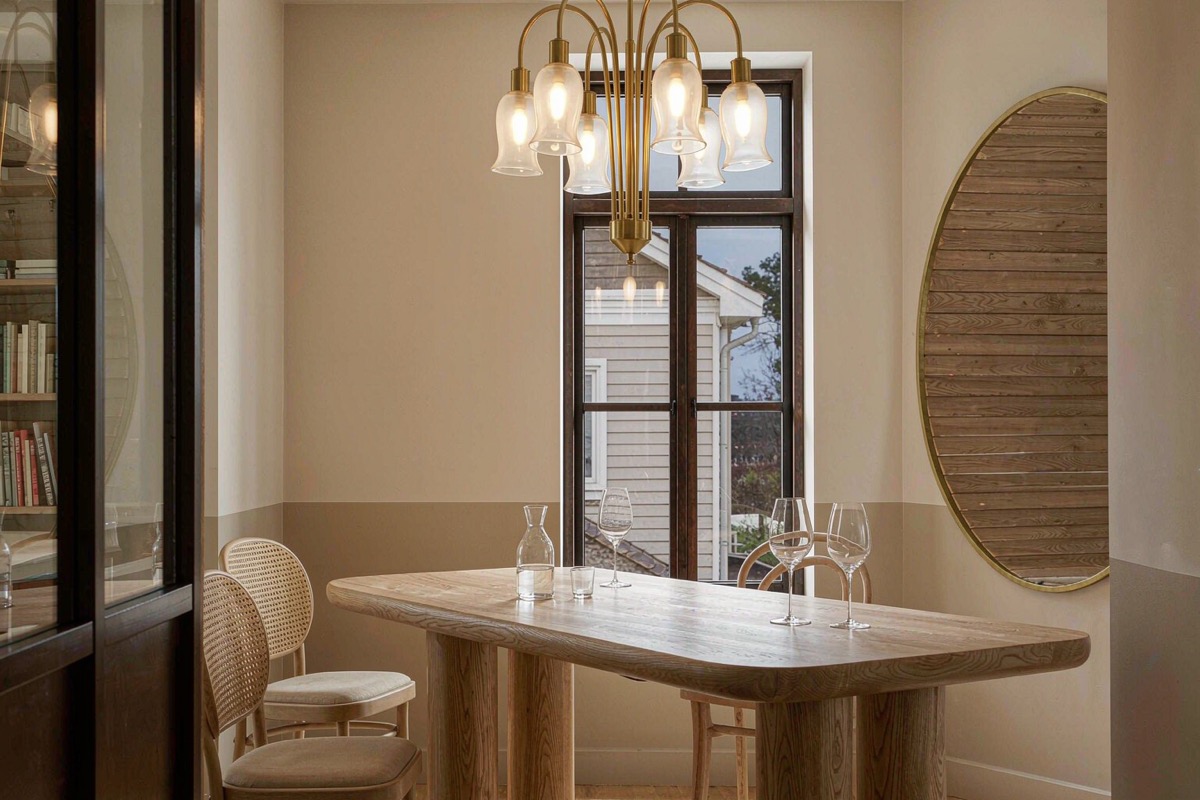
A chandelier weighs forty pounds, ships on a pallet, and costs more to send
back than the chair you returned last month. That single fact shapes almost
everything that can go wrong with an online lighting order, and almost no
product page tells you about it up front. Lighting is the one home category
where the logistics matter as much as the design: the fixture you pick on
Tuesday may be built to order in a workshop, travel three thousand miles by
freight truck, and — if it disappoints — cost you a meaningful slice of its
price to return. None of these are reasons to avoid ordering online. They
are reasons to order differently.
The lead-time problem nobody budgets for
Online lighting catalogs split into two worlds, and the split is usually
invisible until checkout. Stock items — the pendants and vanity bars a
retailer warehouses in volume — ship in days. Made-to-order pieces —
custom finishes, hand-applied patinas, made-to-order chain lengths, anything
from a designer collaboration — are built after you order, and the industry
norm for that build runs six to twelve weeks. A catalog the size of
1800Lighting's, which lists roughly 70,000 products across brands like
Kichler, Hinkley and Visual Comfort, contains plenty of both, and the
product page does not always say which side an item falls on.
The practical failure mode looks like this: a renovation gets scheduled
around a delivery date that was really a ship-by estimate, the electrician
arrives to a bare junction box, and the drywall contractor reschedules
around your missing fixture. Two habits prevent it. First, ask the retailer
— by phone if possible — whether the specific fixture and finish is stocked
or built to order, and get a realistic date. Second, order lighting earlier
in the project sequence than feels necessary; it is the last item installed
and the first one you should buy. Owner complaints about large lighting
retailers cluster around exactly this: orders that arrive late without
notice, or partially fill when one line item runs out of stock. The lesson
from those reports is not that the retailers are bad — it is that a
multi-fixture order has as many failure points as it has line items.
Freight damage: the inspection ritual
A fixture's journey looks nothing like a book's. Anything heavy travels
less-than-truckload freight, gets transferred between trucks two to four
times, and sits in warehouses where cartons get stacked. Glass shades, cast
metal arms and thin brass tubing are exactly the things rough handling
finds. Industry experience puts freight damage on a meaningful share of
fragile shipments, which is why the delivery moment matters more than any
other step in the process.
The ritual is simple and worth treating as non-negotiable:
- Look at the carton before signing. Crushed corners, punctures or
water stains on the box mean damage inside is likely. Note it on the
delivery receipt before the driver leaves — freight claims are built on
that notation.
- Unbox within 48 hours. Concealed damage — a cracked shade inside an
intact carton — is real, and carriers enforce short claim windows.
Photograph everything before assembly.
- Check the hardware count. A missing crossbar or chain is a support
ticket, not a return; retailers of this scale can usually mail a part
faster than a replacement fixture.
What you should not do is install a damaged fixture and decide later. Once
it is wired to the ceiling, returning it stops being realistic — which is
precisely what the return window below assumes you are still able to do.
The return fine print, decoded
Lighting return policies look generous on paper and carry three hooks that
only matter when you use them. The first is the window itself: many
retailers cap returns at 30 days, and a few of the larger stores —
1800Lighting among them, with 90 days — go considerably longer. That part
is genuinely consumer-friendly in a category where the fixture often cannot
be judged until it is on the ceiling.
The second hook is cost. Return shipping on a heavy fixture is rarely free,
and at the example store it comes out of the refund at roughly 10% of the
merchandise cost, with restocking fees possible on some items. A $900
chandelier returned is a $900 chandelier minus a meaningful handling charge.
The third hook is condition: original packaging, all hardware, no installed
wiring cuts. A fixture assembled and hung for a week is a different
transaction than one unboxed and photographed.
Two more policies deserve a glance before any large order. Price-drop
guarantees — the same store credits the difference at 110% if an item's
price falls within 10 days of delivery — reward fast action, and sitewide
sales of around 20% off recur often enough that waiting a week is a
legitimate strategy. One more number belongs in the decision: a fixture
bought at a deep discount usually returns at that same discounted figure,
not the list price you mentally compare it against, so the refund math
should use what you actually paid. And the store's aggregate reputation matters mainly as
a logistics signal: a 4.7/5 on Trustpilot with an A+ from the Better
Business Bureau tells you that when a shipment goes wrong, someone reachable
by phone can fix it — which is the outcome you are actually paying a
specialty retailer for.
The pre-order checklist
Judge a lighting purchase by the logistics as much as the lumens. Before
the order goes out, ask the seller three questions: Is this finish in stock
or built to order, and what is the honest delivery date? What comes out of
my refund if I return this — shipping, restocking, both? And who handles a
freight-damage claim, the retailer or the carrier? The answers sort the
smooth orders from the ones that end with a fixture stuck in a garage until
the dispute closes. Get them in writing, order early, and the online catalog
becomes what it should be: a showroom the size of a warehouse, minus the
parking.