Bathroom lighting has two audiences that never overlap: the room your
guests see and the face you see in the mirror. Most bathrooms serve
neither. One ceiling fixture in the middle of the room puts your own
shadow across everything the mirror shows, and a bath that could read
spa reads institution. The fix is zoning. Light the face from the
sides, keep the wet-zone fixtures rated for where they actually sit,
and put the whole room on a dimmer so the same space can go from
morning rush to a half-lit cave at 11 p.m.
Vanity first: the face is the task
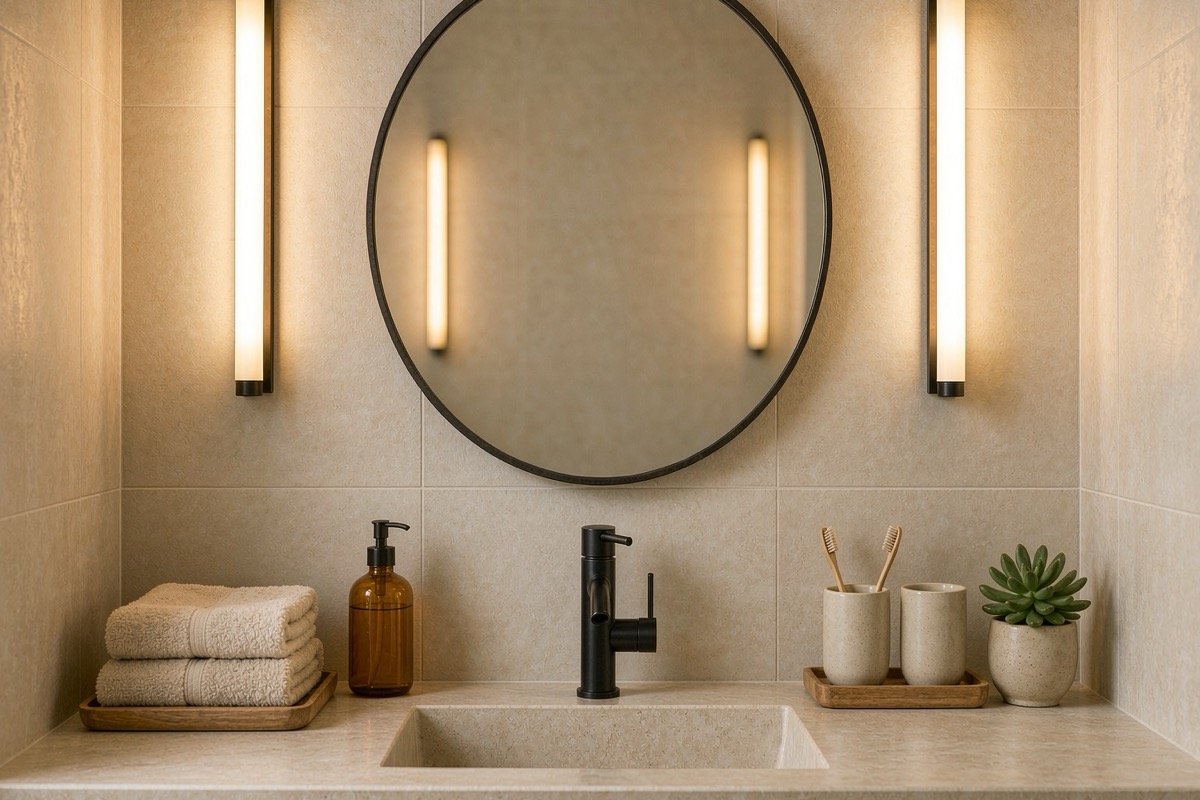
The vanity is where bathroom lighting earns its keep, and it wants
light from the sides, not the top. Overhead light falls straight
down the brow and the nose, carving shadows under the eyes and under
the chin in exactly the places a razor or an eyeliner pencil needs a
clear view. Vertical fixtures flanking the mirror, or a bar just above
it, cross the face with light instead of casting it away. Placed so
the beams meet at around 66-70 inches from the floor, roughly eye
level, they cancel the under-eye and under-chin shadows that a single
overhead fixture guarantees. This is the same task-light principle as
the desk lamp in a home
office: light the surface you
are working on, and here the surface is your face. If wiring beside
the mirror is impractical, a backlit mirror achieves the same
front-light effect with one product. What color that front light
should be is its own decision, and it gets its own section below,
because the vanity is also the one place in the house where a second
color temperature genuinely earns its socket.
The IP zones, decoded without fear
Bathroom electrical rules sound intimidating and reduce to one idea:
the wetter the location, the higher the water-resistance digit. The
two numbers after the letters carry the whole message. The first
covers solids and dust; the second covers water, and water is the one
that matters here. Inside the bath or shower enclosure, IP65 minimum:
the fixture is sealed against dust and against water projected at it
from any direction. Within about 60 centimeters of the basin or shower
edge, IP44, which covers splashes. Everywhere else, the middle of the
room and above the towel rail, ordinary indoor fixtures are fine.
Reading the rating off the box is the entire skill. IP65 survives
steam and direct spray; IP44 survives a splash from the sink. The gap
between those two ratings is why a handsome fixture from the dry end
of the store has no business inside an enclosure, whatever the listing
photos suggest. Shower lights deserve the last word: a sealed IP65
downlight above the enclosure is a genuine luxury, but only with
fixtures actually rated for it, and a steamed-up standard fitting is a
lifetime-safety purchase mistake. The outdoor fixtures in our outdoor
wall lights guide live by the
same IP logic; the code is universal, only the zones move.
Ambient and the midnight dimmer
With the vanity handled, ambient light should be modest and even:
recessed or flush fixtures washing the room at a fraction of the
vanity output. The job is navigation, not illumination. If the
ambient layer is bright enough to read by, it is bright enough to
wake you at midnight. The single best bathroom accessory, though, is
the dimmer. Full light for the
morning rush, 20 percent for the midnight trip; the glaring version
snaps you awake, the glowing one lets you stumble back to bed still
half asleep. Warm smart
bulbs can schedule that dim by
clock, which is a small luxury that reads enormous at 3 a.m. The same
dim-to-warm philosophy that governs bedroom
lighting applies here, and
bathrooms are where most people actually notice it working, because
the mirror doubles everything the light does wrong.
Color temperature at the mirror
Two temperatures share a bathroom, and that is the correct
arrangement, not a compromise. The room lives at warm 2700-3000K,
because nobody wants to be spotlit in cool white at midnight. The
vanity earns one exception: a single neutral source in the 3500-4000K
range, used where makeup actually happens. The logic is blunt. You
will wear that makeup under daylight, office lighting or streetlights,
all of which lean cooler than a 2700K bulb, and judging color under
warm light is asking a question under the wrong lamp.
There is a second number on the box worth checking: color rendering,
printed as CRI. Inexpensive bulbs render skin at a CRI around 80 and
can pull it gray or greenish; bulbs rated 90 and above put the reds
back into the reflection. At a mirror you shave and blend at, that
difference is not subtle, and it costs about the same as the bulb you
were going to buy anyway. Our color temperature
guide covers the full
warm-to-cool map for the rest of the house.
Small bathrooms: bounce and placement
A small bathroom changes the math less than people expect. The mirror
is already a second light source: it bounces back whatever the
fixtures throw at it, which is why the mirror doubles everything the
light does wrong, and everything it does right. Keep the ceiling
fixture out of the sight line between your face and the mirror, or
its glare will sit in the reflection all evening and undo the vanity
work. In a powder room, a pair of sconces plus the mirror's bounce
can be the entire scheme, and the room will read larger for it, not
smaller. One placement habit travels in from every other room: light
the wall, not the middle of the floor, and the space stops feeling
like a corridor with a sink.
What to buy first on a budget
Money spent in this order does the most work. The dimmer comes first;
it upgrades fixtures you already own for the cost of a switch and an
hour, and it touches every hour the room is used. Vanity side light
comes second, because it is the only layer that fixes the shadow
problem at its geometric root instead of hiding it. The sealed IP65
shower downlight is third and optional, a comfort purchase rather
than a safety one once the rest of the zones are handled correctly.
Skip the temptation to spend the whole budget on one dramatic fixture
for the middle of the ceiling. It photographs well, it does nothing
for the face, and its price would have covered both of the things
that matter.
The mistakes that read amateur
Four account for most of it: one fixture doing all jobs (the shadowed
face), cool white everywhere (the clinic look), no IP thinking near
the shower (the safety issue hiding in plain sight), and no dimmer
(the midnight glare). Fix those four and even a rental bathroom with
builder-grade tile reads considered. Light is the cheapest material
in the room and the one guests interact with most. If the bathroom
window looks onto the evening street, the same warmth-outward logic
from the outdoor lighting guide
keeps the glow welcoming instead of clinical from the outside too.