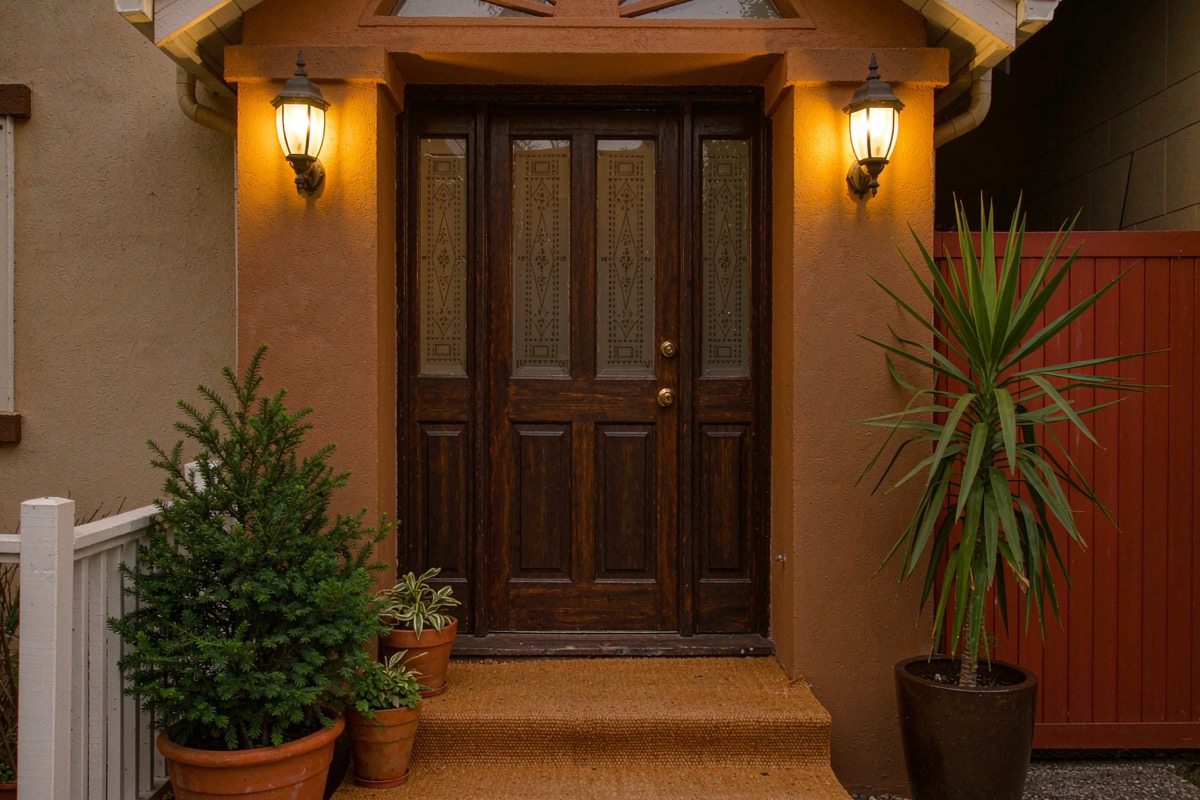
Outdoor wall lights are the handshake of a house — the first thing a guest
meets and the last thing a delivery driver sees. They are also one of the
most commonly botched purchases in home lighting: fixtures sized for
dollhouse doors, and glare where a soft wash was intended. The fixes are all
knowable before you buy. This guide covers
the decisions that separate a professional-looking install from an
afterthought: size, weather rating, light quality, placement and power.
Size: scale to the door, not the shelf
The rule pros use: an outdoor wall lantern should be roughly one-third to
one-quarter the height of the door it flanks. For a standard 80-inch door,
that means a fixture standing 20 to 27 inches tall. Almost everyone underbuys
— a 12-inch sconce that looked substantial in the product photo disappears
against a full-height door from across the street. A quick sight-test before
ordering: tape a cardboard cutout of the fixture's dimensions beside your
door and view it from the sidewalk. If you cannot read its shape from there,
go up a size.
Weather rating: read the IP code honestly
The IP (Ingress Protection) rating on the listing is two digits, and the
second one matters most. IP44 — protected against splashes — is fine under a
deep porch roof. IP65 — protected against jets of water — is the honest spec
for walls that take direct rain. The first digit covers dust and debris; for
most homes, a 4 or 5 there is plenty. Coastal homes should add one more
filter: look for marine-grade or powder-coated finishes and stainless or
brass hardware, because salt air eats cheap zinc plating within seasons — the
same corrosion logic that applies to outdoor furniture hardware in our
Grand Patio review.
Ratings cover water, not neglect. Once a year, clear the fixture's drain
holes so condensation can escape, and check that the gasket around the
wiring entry still sits flush — reseating a dried gasket costs minutes, and
a waterlogged fixture costs the whole unit.
Light quality: warm, layered, and never glaring
Three settings decide whether the light flatters the house:
- Color temperature: 2700K warm white. It matches the interior light seen
through your windows (see our guide to color temperature);
anything above 3000K reads clinical from the street and invites insects.
- Glare control: frosted or opal glass, or a fixture design that hides
the bulb from sightlines. If you can see the bare LED from the sidewalk,
so can everyone else.
- Brightness: entry lighting needs far fewer lumens than people assume —
400 to 800 lumens per fixture is plenty. The goal is a welcome, not a
security flood; flood duty belongs to separate motion-sensor fixtures.
Placement: heights and pairings that read professional
Mount wall sconces so the fixture's center sits about two-thirds of the
door's height — 66 to 72 inches for a standard door — and keep paired
sconces symmetric, topping out near the door's shoulder line rather than eye
level. Over a garage, one fixture between doors is enough; flanking both
doors reads better only when the fixtures are small. Beyond the entry,
down-lit wall washers on the path to a side gate add depth without glare,
and they pair naturally with the low-voltage infrastructure covered in our
Dewenwils transformer review — wall
lights set the scene while the transformer runs the path lights.
Power: the box you have vs. a new circuit
Before the ladder comes out, work out where the electricity comes from.
Replacing an existing fixture is the easy case: the box and wiring are
already there, the breaker goes off, and the job is an afternoon. Running a
new exterior circuit is a different animal — an electrician, conduit, and a
hole through an insulated wall, which rarely makes sense for a single entry
light.
That gap is why plug-in and solar options exist. Plug-in fixtures hang like
hardwired ones but feed from an outdoor outlet through a weatherproof cord
cover; solar fixtures carry their own battery and photocell and need only
screws. The trade is output and consistency: plug-in units behave like mains
fixtures, while most solar units trade brightness for the free install. For
ambience rather than task light, that trade is often acceptable — and for a
quick upgrade, the outdoor string
lights approach delivers atmosphere
without opening a wall at all.
Controls: photocells, timers and motion
The fixture decides how the light looks; the control decides when it runs. A
photocell reads ambient light and switches the fixture on at dusk and off at
dawn, which suits entry lighting: the light is on during exactly the hours
it matters and never left burning at noon. Motion sensors suit side paths
and garages — dark most of the night, full output when someone walks up.
Many outdoor fixtures bundle both modes with a manual override. If you must
choose, photocells favor welcome and motion favors response; a fixture that
offers both covers an entry better than either alone. A plain timer is the
third option, and the weakest: it keeps its schedule while dusk moves with
the seasons, so the light burns in daylight by mid-winter or arrives late in
summer. Photocells track the sky instead of the calendar.
The mistakes that read amateur
Four patterns account for most of the visual failures: undersized fixtures
(the most common by far), mismatched pairs flanking a door, cool-white
bulbs clashing with warm interior light, and bare-bulb glare. Fix those four
and an ordinary entry reads considered — the same principle that governs
layering light in the living room:
no single fixture does the job; the job is making every fixture agree. Start
with size and placement, buy 2700K, and let the fixture specialists
handle the rest of the shortlist.