How to Layer Bedroom Lighting: A Calm-Room Playbook
Bedroom lighting layers explained — ambient, task and night layers, bedside lamp placement, dimmer strategy, and the Kelvin range that protects sleep.
Maya Ellis
Lighting Editor
Last updated:
Bedroom lighting layers explained — ambient, task and night layers, bedside lamp placement, dimmer strategy, and the Kelvin range that protects sleep.
Maya Ellis
Lighting Editor
Last updated:
Spec box
The figures behind each item are in the guide below, with the source named.
Most bedrooms are lit for one activity that never happens: standing in the middle of the room wanting full brightness. Real bedroom life happens in corners and at low speed, and it needs light that dims by zone rather than a single ceiling fixture treating all hours the same. The fix is layering, and the bedroom is the easiest room in the house to do it because the zones are obvious: the bed, the dresser, the door. Three layers, one job each.
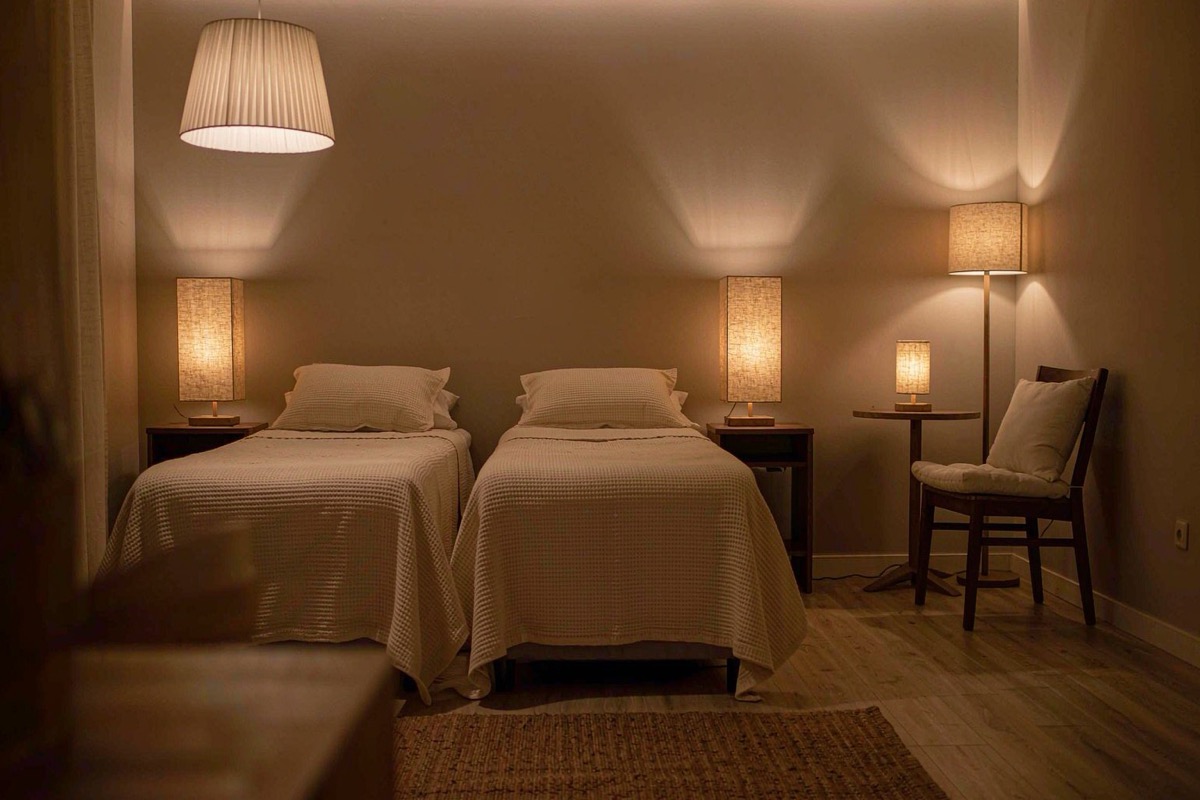
The ambient layer is general light for tidying, dressing and moving through the room, and it should be the dimmest ambient in the house. A bedroom's evening baseline sits closer to candlelight-plus than to living-room brightness. Two softer sources beat one bright ceiling fixture: a pair of wall sconces, a floor lamp in the corner, or an upward-facing wash that bounces off the ceiling instead of glaring off it. The bounce matters more here than in any other room, because a person lying in bed stares directly at the ceiling and every glare point on it. Put whatever you choose on a dimmer switch; this is the layer that carries the room from 7 p.m. to midnight, and it needs range more than it needs output. Keep the color temperature at 2700K or below. The comparison between warm and cool indoor light, and what each does to an evening, is covered in our color temperature guide.
Bedside lamps are the layer people get closest to right, then miss on details. Height first. The bottom of the shade should sit at chin level when you sit up in bed, around 16 to 18 inches above the nightstand surface, so light lands on your book and not in your eyes. A lamp that sits too low forces you to hunch toward the page; one that sits too high lets the bare bulb peek over the shade rim from reading position. Output around 400-450 lumens each is enough to read by without lighting the whole room. If only one side of the bed reads, that side gets the brighter, adjustable lamp and the other side matches it for symmetry anyway. Mismatched bedside pairs read accidental, and the symmetric pair costs nothing extra to plan. A floor lamp beside an armchair serves the same job for the corner reader, and the shortlist for those lives in our warm floor lamp guide.
The most valuable light in the bedroom is the one that stays off your retina at 3 a.m.: a low-wattage plug-in night light near the floor, a sconce on a 5-percent dim, or smart bulbs scheduled to a candle-level glow. Near the floor is not a styling choice. Light placed low marks the path without crossing the bed, and a half-asleep brain climbing out of a warm bed needs very little: the outline of the door, the edge of the dresser, and nothing that demands squinting. The measure of a good night layer is that it gets you to the bathroom and back without waking your partner or fully waking yourself. Smart bulbs earn their keep here. The options we rate in the warm smart bulb guide handle the scheduling, and a pair of plug-in sconces can double as dim night markers when the main lights are off.
Every evening layer in the room sits under one rule: 2700K or below. The reason is melatonin, the hormone that starts the wind-down, and the fact that cool white light suppresses it far more than warm light does. A 4000K bedroom quietly keeps you alert past the hour you meant to be asleep, working on you the same way a screen does, while a warm bulb barely touches the mechanism. This is the one room where the color temperature matters more than the fixture design, because the hours it runs in are exactly the hours the body is deciding whether tonight is over. The bathroom earns a neutral bulb at the vanity because color accuracy is its job there; in the bedroom, a cool bulb is simply working against the room. Save the 4000K inventory for the kitchen, where seeing what you are chopping is the actual task.
Layering fails at the switch plate more often than it fails at the fixture. If the ambient pair, the bedside lamps and the night light all run off a single gang by the door, the layers technically exist but you will never use them separately, and the half-asleep version of you will not walk across a cold floor to find out. Each layer gets its own control, and the controls you touch most go where you actually are: the bedside lamp within reach from the pillow, the ambient dimmer by the bed and not only by the door. Smart bulbs fold the switch into a phone or a voice command, which solves the reach problem but adds one dependency worth knowing before you buy: the lamp still has to be left switched on at the wall for any of the smart control to work.
Putting it together by layout: a small bedroom needs three sources, an ambient pair or corner lamp, two bedside lights and one night light, and nothing more. A primary bedroom adds a reading corner with its own floor lamp and a vanity or dresser light for getting ready. Cool-leaning there is forgivable, since accuracy beats mood when you are matching socks.
The same zone-thinking that organizes furniture placement in our small bedroom layout guide applies to light: one job per source, every source on its own control, and the whole room dimmable from the bed. If the layers feel abstract, the living room version, the full method in our layered lighting guide, is the same framework with louder furniture.
Four failures account for most bedroom regret. The single overhead fixture doing all three jobs comes first, and it is why so many bedrooms feel either institutional or unusable. Reading lamps mounted too low come second: the light lands in your eyes instead of on the page, and reading quietly stops being something you do in bed. One switch for everything is third, for the reasons above. The quiet fourth is a cool bulb bought on sale and installed everywhere, because it keeps the room awake at the exact hour the room's job is to let you fall asleep. None of the fixes costs much, which is what makes the pattern so common. Households spend on the mattress and stop there, and the light quietly follows the budget down.
Three: an ambient layer for general evening light, a task layer for reading in bed, and a low night layer for the trips you make half-asleep. A single overhead fixture forces all three jobs onto one switch and one brightness, which is why bedrooms so often feel either institutional or unusable.
Around 400 to 450 lumens per bedside lamp — bright enough to read by without lighting the whole room. Point the light at the page, not the pillow: an adjustable arm or a shade that sits below eye level when seated does the work.
2700K or below for every evening layer. Warm light barely touches melatonin compared with cool white, which is why a 2700K bedroom winds down while a 4000K one quietly keeps you alert past bedtime.
Sofia Lund
Editor-in-Chief & Kitchen / Dining
How Ceramic Coatings Die: Abrasion, Thermal Shock and the 18-Month Curve
Daniel Hart
Furniture / Bedroom
Why Bed Frames Squeak — and Which Design Decisions Keep Them Quiet
Maya Ellis
Lighting
Why Your Dimmer Buzzes: Flicker, Load and Picky LED Fixtures
Updated October 10, 2026 · Maya Ellis
Updated October 9, 2026 · Maya Ellis