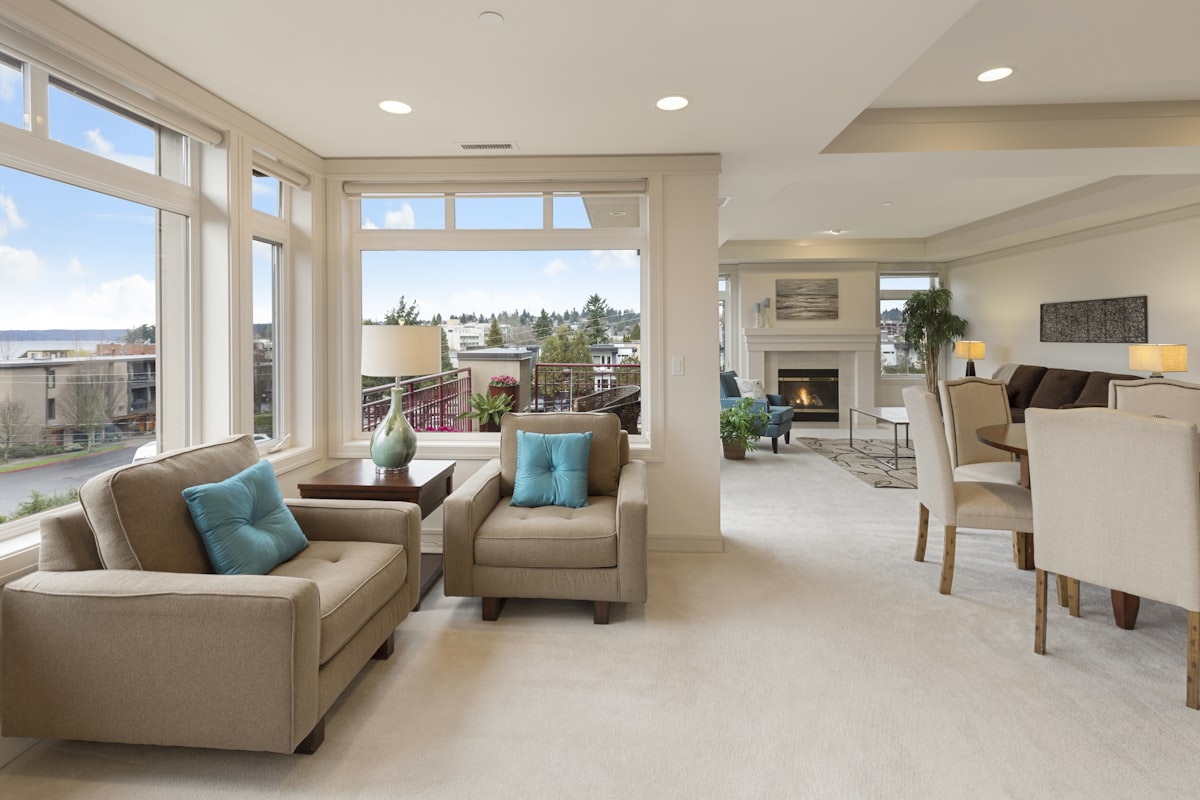
More than twenty living and dining rooms measured for this piece, and the
wrong-looking ones kept failing the same way: a rug one size too small.
Furniture was fine, lighting was fine — the rug just floated in the middle
like a bath mat. The good news is that rug sizing has fewer rules than most
people fear, and they're consistent.
Rule 1: Front legs on, at minimum
In a living room, at minimum the front legs of every seat should sit on the
rug. A rug that sits under the coffee table alone makes the whole seating
group look scattered. Full coverage — all four legs on the rug — looks the
most intentional, but front-legs-on is the standard that works in most rooms
and costs less square footage.
Rule 2: Show some floor around the rug
The rug should stop 12 to 18 inches from the walls in a living room, closer
to 8 inches in a small room. This is the rule people break most: they buy the
biggest rug that fits and lose the floor frame entirely. The visible border
of flooring is what makes a rug read as a choice rather than wall-to-wall
carpet that got cold.
Rule 3: Chairs must clear the rug when they pull out
Measure your table with the chairs pulled out — the way they sit when someone
is actually sitting down. That footprint plus a few inches is the minimum rug
size. A rug whose edge catches chair legs every time someone pushes back is
worse than no rug at all; it wobbles, it wears, and it's infuriating within a
week.
Rule 4: In the bedroom, work outward from the bed
You don't need a rug wide enough for both nightstands. An 8x10 under a queen
bed, or two runners flanking it, does the job: the test is that your feet
land on something warm on both sides of the bed. Anything narrower than the
bed plus two feet of margin on each side is a runner pretending to be a rug.
Three sizes cover most homes
If you only memorize three numbers: a 9x12 handles most living rooms with
front legs on, an 8x10 handles queen-bed bedrooms and smaller living rooms,
and a 6x9 or 8-foot round handles dining sets up to a four-seater. Buy the
larger size when torn, and return the too-small one — a rug that's too big
for a room is a solvable problem, and a rug that's too small never is.
The five-minute check
- Every seat in the living room: front legs on the rug?
- Can you see 12 to 18 inches of floor between rug edge and wall?
- Dining chairs pulled out — do all four legs stay on the rug?
- Bedroom: do your feet land on rug on both sides?
Rooms with the right rug size don't feel bigger. They feel finished.