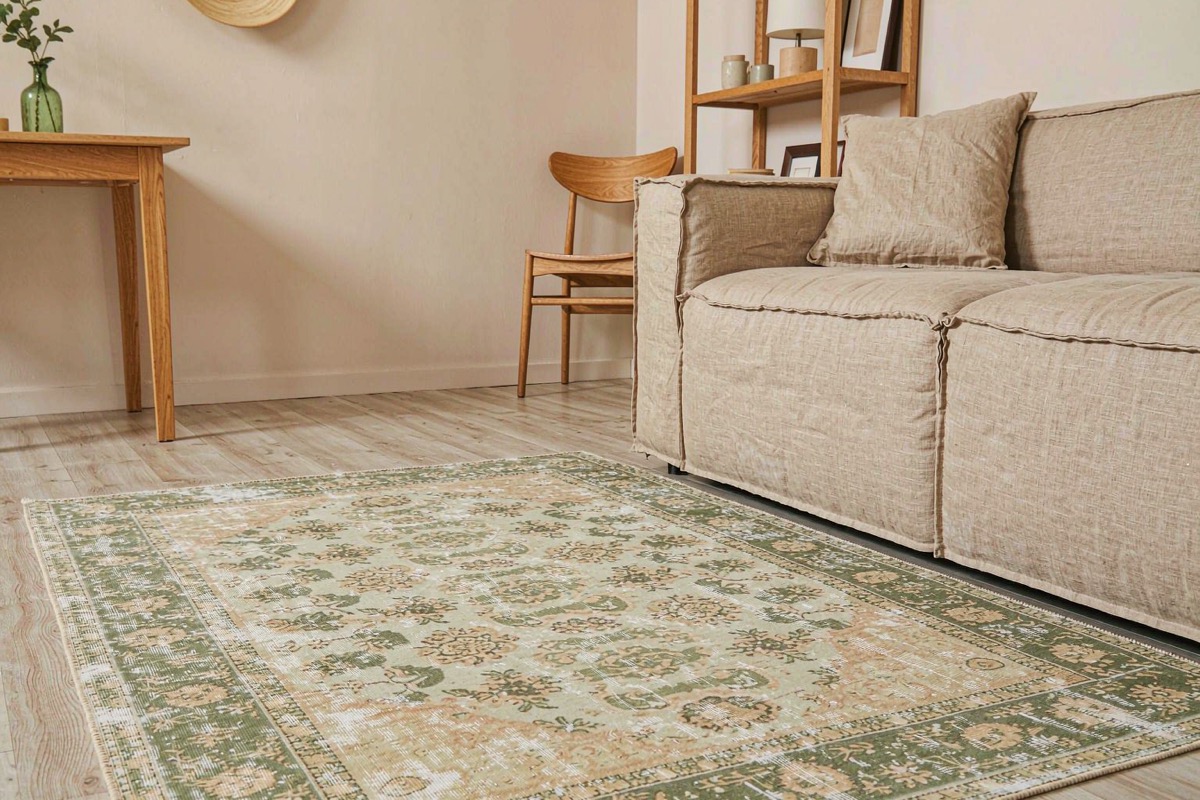
The hardest engineering problem in a washable rug is not the stain. It is
the contradiction built into the floor itself: a rug needs to grip so it
does not slide, while a washing machine needs everything in the drum to
flex, agitate and drain. Any material grippy enough to hold a rug steady
on hardwood is, by its nature, a material that dislikes hot water, spin
cycles and being folded into a drum. Every washable rug on the market is
one answer to that contradiction, and the answers split into two families
that behave very differently after a year of laundry.
The fiber: why it is almost always polyester
Machine-washable pile is dominated by synthetic fiber, and polyester wins
on three measurable properties. First, it is hydrophobic: the fiber itself
absorbs little water, so most of what a washing machine removes is the
water trapped between fibers rather than inside them, which shortens dry
time dramatically compared with cotton or wool. Second, polyester holds
pigment well, which is why the category is full of saturated vintage-print
surfaces that survive repeated hot cycles without washing out. Third, it
is thermoplastic, meaning the fiber can be heat-set into a low, dense pile
that resists matting.
Wool and cotton can appear in washable constructions, but both carry a
penalty in the drum. Wool felts when agitated wet — the scales on the fiber
lock together and the pile compacts permanently — so wool washables require
cold water, gentle cycles and careful drying. Cotton absorbs water into the
fiber itself, which makes a cotton rug heavy, slow to dry and prone to
shrinking. These are not disqualifying flaws, but they change the product
from "throw it in with the towels" to "treat it like a wool sweater," and
that difference is exactly what the polyester-dominant category exists to
avoid.
Pile height is a drying-time spec
The thin, flat pile that defines this category is not a styling choice; it
is the direct consequence of the laundry requirement. Pile height controls
three things at once: how much water the rug holds when it comes out of the
spin cycle, how long it takes to dry before mildew becomes a risk, and how
much mass thrashes against the drum walls. A low-pile construction —
typically a few millimeters — dries in hours rather than days, fits under
door sweeps without binding, and keeps total wet weight within reach of a
household machine.
The trade-off is underfoot feel. Nobody should expect the plushness of a
thick wool rug from a construction engineered to survive laundry, and owner
feedback across the category — including on lines like Lahome's, one of the
brands that made washable rugs mainstream — divides consistently on exactly
this point: the thin pile reads as practical to some buyers and as thin to
others. Judge it by the numbers before ordering: if a rug's listed pile
height is in the low single-digit millimeters, you are buying a padded mat
with a printed surface, and no pattern changes that.
The backing is the part that actually fails
Ask what breaks first in a washable rug and the answer is almost never the
face fiber — it is the backing. The non-slip layer has to keep its grip and
its flexibility through dozens of hot, wet, agitated cycles, and the
chemistry that survives that treatment is a short list. Thermoplastic
elastomers such as TPR are the current standard because they tolerate heat
and detergent without hardening.
Latex and budget rubber compounds cost
less but tend to oxidize, crumble and shed particles into the drum within
the first dozen washes.
Backing chemistry also decides whether a rug is one piece or two. In a
one-piece construction, the backing is bonded or fused directly to the rug,
so the whole object goes into the machine together. In a two-piece system,
the rug is a detachable cover that grips a separate permanent pad — usually
through a grid of hooks or a friction interface — so each wash involves
pulling the cover off, washing only the cover, and reattaching it to the
pad. The two-piece design exists because it solves a real physics problem:
the heavy, absorbent pad never needs washing, so the machine only handles
the light cover, which cuts wet weight and dry time substantially.
Why the two pieces separate — and what keeps them together
The two-piece system's weakness is built into its name. A cover that
attaches by hooks or friction is a system with a defined failure mode: the
connection points work loose, corners lift, and the cover migrates on the
pad until it wrinkles underfoot. Hook density is the spec that predicts
this — more connection points spread the load, fewer concentrate stress at
the corners where traffic first pulls. Reattachment after every wash is
also a wear event in itself; a system rated for hundreds of cycles is
being asked to survive hundreds of small peel tests.
One-piece rugs sidestep that failure mode and take on a different one:
delamination. If the bonded backing and the face fiber expand at different
rates through repeated heat cycles, the bond line is stressed every wash,
and a cheap bond eventually separates into a rug that grips on one side
and slides on the other. There is no consumer test for bond quality before
purchase, which makes the brand's wash-cycle track record the only usable
signal — this is the one place in the category where owner-report patterns
across a year or more of use genuinely outrank the product page.
What the drum does to a rug
Even a well-engineered washable rug meets real constraints in the laundry
room. Weight is the first: a soaked 5x7 can pass twenty pounds, and an
overloaded drum cannot agitate or spin properly, which leaves a soggy,
poorly cleaned rug and a strained machine. Checking drum capacity against
rug size before ordering is the single most predictive step in the whole
purchase. Fold lines are the second: shipping compression sets creases
that need several days unrolled — reverse-rolling or weighing the corners
down speeds this up — before the rug sits flat. Cycle choice matters more than most instructions admit. Hot water is fine
for the polyester face but hard on the backing; a warm or cool cycle with
a normal spin, followed by air drying flat rather than machine drying,
aligns with how these constructions are tested. Heat from a dryer is the
fastest way to age a backing compound, and it is the one shortcut the
chemistry does not forgive.
Before you order
The category rewards three checks made in order. First the washer: measure
the drum and match it to the largest size you will realistically wash,
because a rug you cannot launder is not a washable rug. Then the backing:
one-piece bonded, or two-piece detachable — and if two-piece, how dense
the attachment grid is. Finally the pile: millimeters listed honestly,
with the understanding that thin dries fast and feels thin. Brands like
Lahome built the category by bundling the backing into the rug at entry
prices, which is the right first experiment for most households; the
construction questions above are what turn that experiment into a rug you
keep washing rather than one you quietly stop.