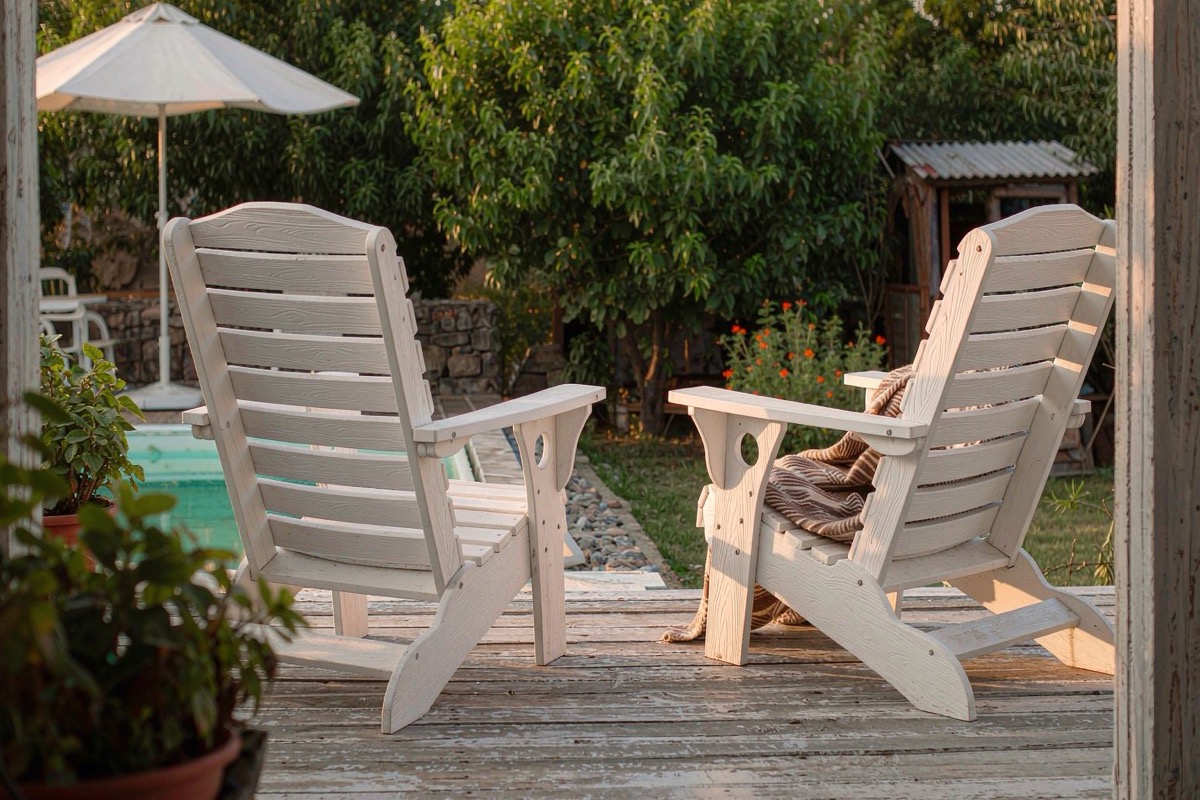
Outdoor furniture materials make a strange set of promises. Teak promises
to outlive you if you oil it, and to gray gracefully if you do not. Resin
wicker promises convenience and delivers, too often, a chair that
unravels where the sun hits it. Poly lumber promises nothing will ever
happen to it, ever. All three promises are true — within conditions that
nobody prints on the price tag. Here is what each material actually does
when the weather gets to work.
The enemy is not water. It is the sun, and the cycle
Rain gets blamed for most outdoor furniture death, but the real
combination is ultraviolet radiation plus moisture cycling. UV breaks
down lignin in wood and plasticizers in vinyl; moisture swelling and
drying opens cracks that UV then widens; freeze-thaw turns hairline
checks into structural ones. Any material claim worth trusting is a claim
about how it handles that specific loop — sun, wet, dry, freeze, repeat —
for years, unattended.
Teak: the gold standard, with a maintenance schedule
Teak's reputation rests on natural oils and a dense grain that resist
rot and insects without any treatment. Left alone, teak weathers to a
silver-gray that is structurally sound — the color change is surface
oxidation, not decay — and a teak bench can serve for 40 years and more.
That is the promise, and it is real.
The conditions: teak is expensive enough that it prices like furniture
rather than patio gear, genuinely so because the wood grows slowly and
plantation supply is finite. And the "low maintenance" claim needs
reading. Low maintenance is not no maintenance — left unoiled, teak
grays, develops small surface checks, and lifts tannins that stain
nearby stone. Keeping the honey tone requires annual oiling or sealing,
and even then the surface is a food source for mildew in humid climates.
Teak's failure mode, in practice, is neglect showing up as aesthetics
rather than structure — which is either acceptable or not, depending on
whether you bought the wood for its strength or its color.
Resin wicker: convenience with a weave problem
Resin wicker — PVC or HDPE strands woven over an aluminum frame — is the
look people want at a price teak cannot touch, and modern all-weather
weaves handle rain without complaint. The frame rarely fails; aluminum
does not rust and the weave sheds water.
The failure mode is photodegradation of the weave itself. Cheap wicker
strands use PVC with marginal UV inhibitors; after two or three seasons
of direct sun, the strands stiffen, fade, and begin to crack at the
weave's tightest bends — usually the armrests and seat edges, exactly
where load and sunlight overlap. Once one strand goes, the weave unravels
along its length, and no repair is practical. Better weaves use HDPE
strands with UV stabilizers throughout the material and last
correspondingly longer, but the category's price spread maps almost
perfectly onto strand quality, which is invisible at purchase and
decisive by year four. The spec that matters, if the seller states it:
strand material and whether UV inhibitors are compounded in, not sprayed
on.
Poly lumber: the material that opted out of the weathering cycle
Poly lumber is extruded HDPE — the same plastic family as milk jugs —
formed into boards and shapes that imitate wood construction. Its
engineering claim is total: nothing for UV-plus-moisture to attack
structurally, no finish to fail, no grain to check. Colors are
pigmented through the full thickness of the material, so fading is the
only honest failure mode, and well-formulated HDPE with UV stabilizers
delays even that for years.
The category's quality spread runs through formulation and hardware.
Marine-grade stainless fasteners — 304 stainless and up — matter because
the boards outlast cheap hardware by a decade; rust streaks on a poly
chair are fastener failure, not material failure. Load ratings separate
the tiers too: a chair tested to the ASTM outdoor-furniture standard at
400 pounds, as Highwood's Hamilton Adirondack is, is telling you about
joint engineering as much as material strength, since HDPE boards flex
more than wood and the joinery has to compensate.
The case study worth studying is Highwood USA, a Pennsylvania company
that has extruded its own high-density poly lumber for more than two
decades — material that also shows up in America's largest theme parks
and municipal installations, which is the durability reference class
that matters. Its Hamilton Folding & Reclining Adirondack chair holds a
4.3-star average across 603 Amazon ratings and its Classic Westport
carries 4.4 stars across 142; the owner praise concentrates on woodgrain
texture molded deep enough to read as wood at conversational distance,
and hardware that survives coastal winters. The complaints are the
material's honest limits: sunscreen transfers onto armrests and stains
lighter colors — darker finishes or a quick wipe are the documented
fixes — and a minority of owners report fading after years of intense
sun. The 12-year residential warranty versus the 3-5 years typical of
imported poly is the clearest single number for what formulation quality
buys.
The direct comparison, season by season
Year one: all three look identical in a catalog photo. Year three:
unoiled teak has grayed, cheap resin wicker has begun to stiffen at the
arm bends, poly lumber looks as it did on delivery day. Year seven:
maintained teak is a family heirloom, neglected teak is gray but sound,
mid-grade wicker has replaced strands or the whole chair, poly lumber
shows its first honest fade on the sun-facing side of lighter colors.
Year twenty: teak persists, wicker has been replaced once or twice —
often at higher total cost than either wood or poly — and quality poly
lumber is on its second color scheme, having never been sanded.
Total cost of ownership flips the sticker order: teak is expensive once,
wicker is cheap repeatedly, poly lumber is mid-priced once.
Choosing by climate, not catalog
Coastal and four-season climates punish every wood finish and every
cheap fastener; poly lumber and teak are the two materials that treat
salt air and snow cover as irrelevant, which is why both dominate
seaside rentals. High-UV climates — the desert Southwest, high-altitude
sun — make the strand-and-pigment quality of wicker and poly the
deciding spec, because everything fades there; dark poly finishes and
UV-stabilized weaves are the answer. Shaded, humid patios are mildew
country, where nonporous materials beat wood on cleaning ease regardless
of price tier.
The material decides the maintenance schedule before the furniture
decides anything. Pick the schedule you will actually keep, and the
weathering question answers itself.