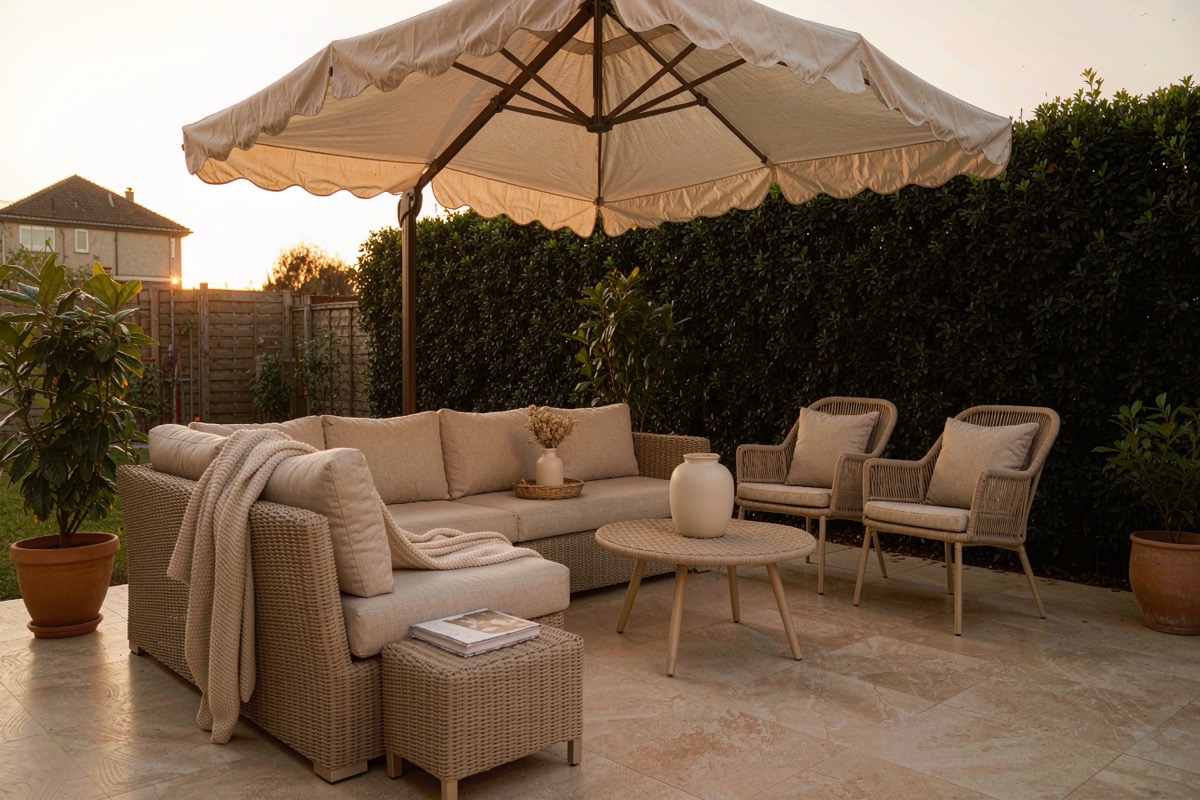
A patio umbrella is a sail that has agreed to behave. That is the framing
most first-time buyers skip, and it explains almost every umbrella failure
you have ever seen in a neighbor's yard: the bent post, the snapped crank,
the base that walked three feet across the deck in a spring storm. The
physics never stopped. The engineering is about how much of it you accept.
The sail problem, quantified
Wind load on a canopy scales with area and with the square of wind speed.
An 11-foot round canopy presents roughly 95 square feet of fabric; in a
20 mph gust, that is a meaningful amount of force delivered at the top of a
7-to-9-foot lever arm. The force at the base multiplies accordingly, which
is why base weight is not a suggestion but the load-bearing spec of the
entire product.
Center-post umbrellas put that lever through a table, which helps — the
table's weight and the umbrella share the load path. Cantilever umbrellas
remove the table and keep the lever: one post, an arm reaching out, and the
entire counterweight job falling on the base. The arithmetic for a typical
11-foot cantilever lands around 374 pounds of fill — about 330 pounds of
sand plus 44 pounds of water. Sand wins on density and never evaporates;
water adds mass cheaply and drains for winter storage. Most wheeled bases
take both.
Here is the counterintuitive part: the fill is not on any spec sheet that
matters, because manufacturers list base weight empty. The difference
between a 40-pound wheeled base and the same base filled is 300 pounds of
performance that only shows up on the gustiest day of the year — or doesn't.
Owner data makes the stakes concrete. The Grand Patio Napoli, an 11-foot
cantilever with a wheeled fill-base, holds a 4.3-star average across
roughly 2,000 Amazon ratings, and among the praise is a repeated detail:
bases holding firm through gusts near 30 mph once filled to spec. The
corollary appears in the complaint column — the single most repeated defect
report is not a broken frame but a base that arrived missing from a
two-box shipment, which tells you where the failure point of the product
category actually lives.
The structure: posts, cranks and the mechanics of tilt
The post is the next engineering decision. Straight aluminum posts are
cheap, light and rigid enough for center-post designs. Cantilevers favor a
curved or articulated post — not for looks, but because the curve lets the
canopy rotate and reposition around the pivot without the whole umbrella
walking. Rotation on better cantilevers runs 360 degrees, sometimes by foot
pedal so your hands stay free, which turns the umbrella from a fixed shade
into a tracking one: you move the shade as the sun crosses, not the
furniture.
The crank-and-lift system raises the canopy by winding a cable through
pulley points, and it is the most common mechanical failure on any
umbrella: cheap cranks strip their gears under the tension of a wet canopy.
Quality shows up here as a heavier crank housing and cable guides that
keep the cable from jumping the pulley.
Tilt mechanisms come in three flavors. Collar tilt — a twisting collar
above the crank — is the cheapest and the most convenient, but it adds a
wobble point at the top of the post. Push-button tilt hinges the post at a
fixed joint and is sturdier but coarse, usually two or three positions.
Manual repositioning — picking up the whole umbrella — is what cantilevers
sidestep entirely with their rotating arms. The design detail people miss
until they live with it: handle height. On one popular cantilever, the
tilt handle sits high enough on the post that a 5-foot-5 tester could
barely reach it, as Bob Vila's review noted. Whoever will actually crank
the umbrella should be able to reach the controls — measure the person, not
just the patio.
Frame material deserves its own thirty seconds, because it determines
how the structure ages rather than how it stands. Powder-coated
aluminum is the category standard — light, rustproof, and rigid enough
at the gauges used in quality cantilevers — but coating thickness
varies, and a thin powder coat chips at the joints where the post
meets the base, letting oxidation start exactly at the stress point.
Steel frames are heavier and stronger per dollar but need the coating
even more; a scratched steel post rusts from the scratch outward.
Check the joints, not the canopy, when judging build quality in a
showroom: welds should be continuous rather than tacked, and hardware
should be stainless or plated rather than bare. The rib count inside
the canopy matters too — six ribs is the budget floor, eight is the
durable standard, and each rib is one more line of defense against the
flutter fatigue described above.
Fabric: the spec that decides whether the canopy survives three summers
Canopy fabric comes down to two numbers: weight and dye method.
Weight, in grams per square meter, tracks tear resistance and how the
canopy handles repeated open-close cycles. Lighter fabrics flutter, and
flutter is fatigue — thousands of tiny stress cycles that end in a tear
along the ribs. Heavier fabric flutters less and lasts longer.
Dye method decides fade life. Solution-dyed acrylic puts color into the
polymer before the fiber is extruded, so the color runs through the
material's full thickness; dyed polyester colors the surface only, and the
sun strips it from the outside in. This is why Sunbrella can put a 5-year
fade warranty on its acrylic — the warranty is the dye chemistry, stated
as a promise. A 270gsm solution-dyed acrylic canopy is the class of fabric
to buy for a yard with full-day exposure; surface-dyed polyester is
perfectly reasonable for a part-shade courtyard and costs half as much.
UPF ratings ride along on the better canopies — UPF50+ means the fabric
transmits one-fiftieth of the UV that hits it, which is genuine protection
rather than marketing, and it comes free with tight weaves and dark or
deeply dyed fabrics.
Sizing without regret
Two rules cover most mistakes. Coverage first: a canopy should shade the
seating area with margin, and a 10x13-foot rectangular canopy covers an
eleven-piece dining set where an 11-foot round does not — rectangles suit
tables, rounds suit conversation pits. Weight second: decide where the
base lives before buying, because a cantilever that cannot be filled to
spec on a balcony with load limits is a sail with a deadline. If the fill
weight is impossible, a center-post umbrella through a heavy table is the
honest alternative.
The last rule is operational, not mechanical: close the canopy when you
are not under it. Every wind figure any manufacturer implies assumes a
closed canopy, and the umbrellas that survive decades are the ones whose
owners treat open-and-unattended as the abnormal state.