The spec nobody checks when buying closet organizers: the shelf they
will sit on. A fabric cube rated to hold a king-size sheet set is
meaningless if the wire shelf underneath it bows like a hammock, and
the heaviest tower of bins in the world is one drywall anchor away
from ending up on the floor. Closet storage fails at its weakest
structural link, and that link is almost never the organizer you
picked from the listing photos — it is the wall, the bracket, or the
forty-year-old wire shelf the organizer now concentrates its weight
onto. SpaceAid makes a useful case study here, because its catalog is
exactly the kind of add-on storage most people layer onto existing
shelving, and its owner data shows what happens on both sides of that
interface.
Three ways a closet carries weight
Every closet storage system belongs to one of three structural
families, and each fails differently.
Wire shelving is the builder-grade default in most American closets:
horizontal ventilated wire spans held by brackets screwed to the wall
or to a back rail. Distribute a load evenly and a sound 4-foot span
handles roughly 50 to 100 pounds, per typical manufacturer ratings.
But wire is a grid of thin rods, not a plane. Set a small-footprint
object on it and the object bridges only a handful of crossings, so
its entire weight rides on a few wires. That is why a stack of books
dents wire shelves in a way a pile of sweaters never will, and why
the standard fix is a solid deck — a cut piece of plywood or a board
laid over the wire — under anything with small feet.
Solid shelving, whether a fixed wooden organizer or a simple board on
brackets, spreads load across a real plane. Its failure mode is sag:
span is the enemy, and a shelf spanning more than about three feet
under books or stacked linens will show a visible curve over the
years unless the material is thick enough or there is mid-span
support. Material matters less than people expect; thickness and
span matter more. A solid shelf also changes the wall question, since
its brackets — not the shelf — are what actually hold the weight.
Track and rail systems are the structural overachievers: vertical
standards anchored to studs, with shelves and rods hanging from
adjustable hardware. Load travels from shelf to bracket to rail to
studs, and a properly installed system turns the whole wall into the
support — hundreds of pounds, rated per linear foot by the
manufacturer. The catch is that the system's rating assumes stud
attachment. The same rails on drywall anchors alone inherit the
anchors' rating, and a typical heavy-duty toggle in half-inch
drywall holds a fraction of what a stud does in shear. The hardware
aisle sells hope; the stud finder sells the real number.
What add-on organizers do to these structures
Add-on organizers — the fabric cubes, stackers and rack inserts —
add load without adding structure, and the interaction goes one of
three ways depending on the base.
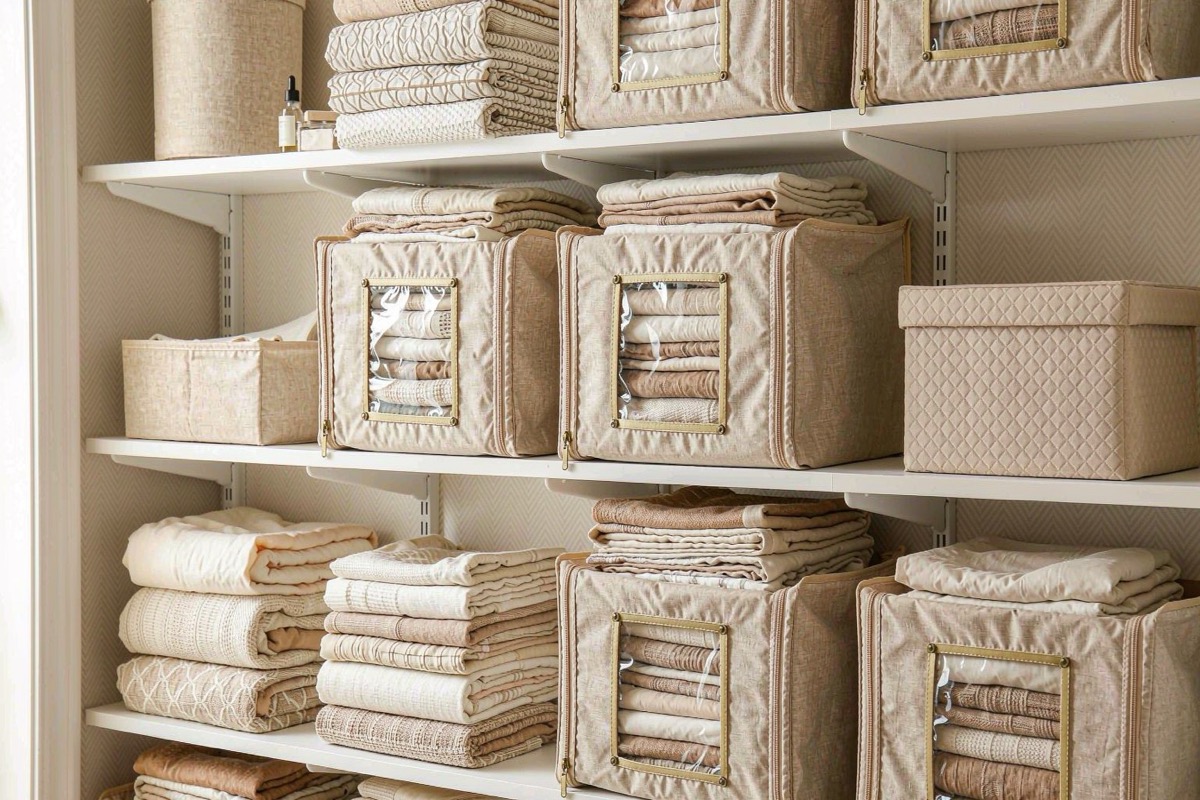
On a solid shelf, they behave. SpaceAid's signature bed sheet
organizers are the clean example: each fabric cube measures 15 by 5
by 12.8 inches, holds one queen or king sheet set with a duvet cover
and two pillowcases, and rests its full weight on the shelf below. A
loaded cube of linens lands on the order of ten pounds — no structural
event for any sound shelf. The Amazon record backs the use case:
4.6 stars across nearly 4,000 ratings, with the recurring praise being
that a linen closet finally looks intentional. The recurring
complaint, notably, is not structural at all. Zipper durability leads
the quality concerns, and the sizing trap is clearance — 12.8 inches
of shelf height needed, which skipped tape measures keep discovering.
Both are interface problems between organizer and closet, which is
exactly the layer most buyers never measure.
On wire shelving, the same cube is a point load riding on a few wire
crossings, and heavy contents make it worse: the water bottle
organizer, rated 4.5 stars across 852 ratings, works by stacking
tumblers into vertical columns — a brilliant use of cabinet volume
that also concentrates the weight of a dozen stainless bottles onto
a footprint the size of a shoebox. On wire, that footprint bridges
almost nothing. The engineering answer costs about five dollars: a
solid deck under the organizer, which converts wire shelving into
solid shelving for exactly the spot that needs it.
On track systems, add-ons are trivially safe — the wall is doing the
work — and the real load conversation moves to the system's own
accessories and how many linear feet of studs the installer found.
Reading weight ratings like an engineer
Three habits keep the structure honest. First, ask where the load
path ends: every pound of storage terminates in either a stud, a
masonry anchor, or a friction fit in drywall, and only the first two
have ratings worth trusting. Second, distinguish distributed from
concentrated ratings — a shelf rating assumes spread-out weight, and
organizers exist precisely to concentrate weight. Third, treat
assembly-included furniture honestly: the kids' bookshelves and toy
organizers at the top of SpaceAid's catalog, in the $100 to $130
range, arrive flat and carry loads appropriate to their price tier,
which is fine for books and toys and worth thinking twice about
before a tower of hardbacks meets a floating shelf.
One more number discipline before any order: measure twice, in both
directions. Height clearance decides whether a cube fits under the
shelf above it, depth decides whether a rack sticks past the shelf
edge, and the width of the opening decides whether the assembled
unit can physically enter the closet. The 4.7-star spice rack line
across 336 ratings earns its score by solving visibility — step tiers
keep every jar label readable — but the same step tiers add height,
and a shelf with a lip or an overhead unit does not negotiate.
Match the system to the load
The honest summary is a matching problem. Wire shelving takes light,
distributed, soft loads for free and needs a deck for anything with
a small footprint. Solid shelving takes concentrated loads within its
span and repays attention to bracket quality and mid-span support.
Track systems take the heaviest loads in the closet and demand studs
in trade. Fabric cubes, bottle columns and tiered racks are the
finishing layer that turns dead volume into sorted storage — they
organize, but the structure beneath them carries. Judge a closet by
the numbers first: what is anchored to what, over what span, and
what actually sits beneath the organizer in the cart. The pretty
part of the closet is always standing on the boring part.