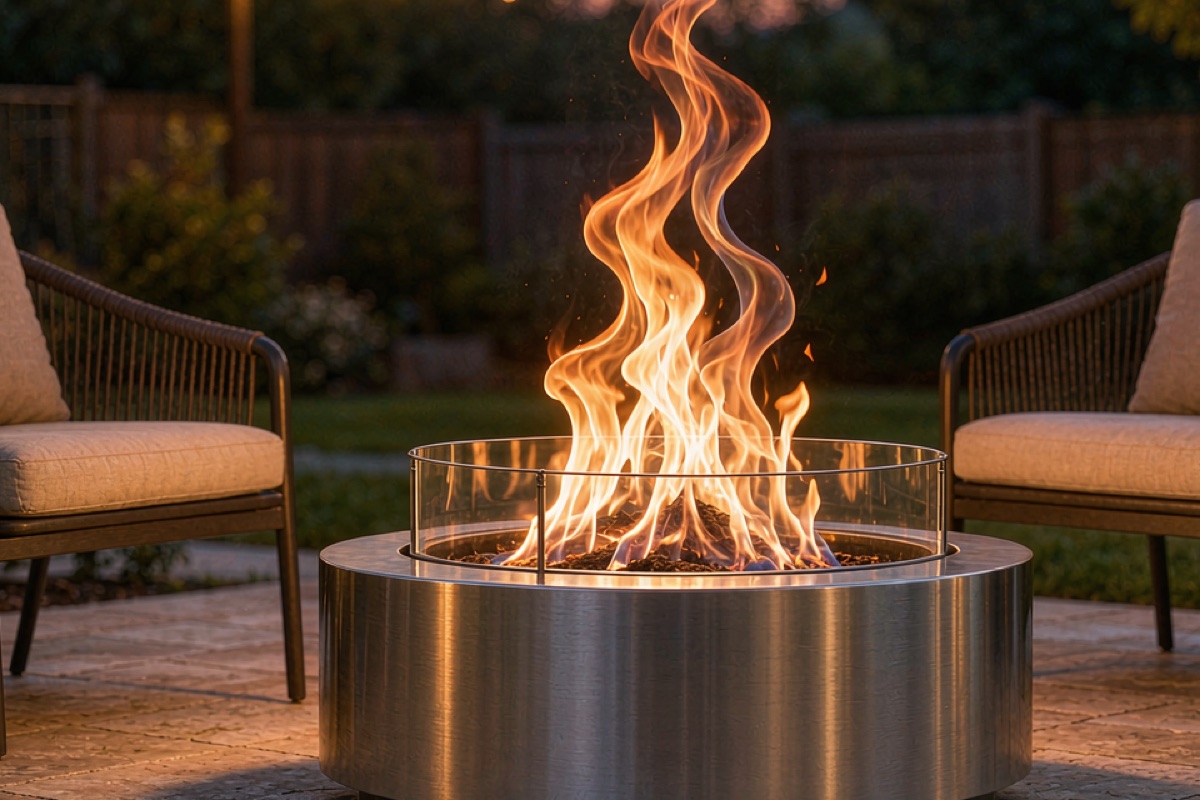
Here is the counterintuitive spec: a smokeless fire pit is not a fire
pit with a filter. There is no mesh screen trapping particles, no
catalytic converter, no moving parts at all. The entire smoke-control
system is a gap between two walls of steel, about the width of a
pencil, and the fact that hot air rises. Get that one detail right and
the smoke that used to chase your guests around the patio gets pulled
back into the fire and burned a second time. Solo Stove built the most
recognized version of the design — a double-walled 304 stainless steel
bowl with 360-degree airflow at the base — and it makes a clean
teaching case, because every smokeless pit on the market is a variation
on the same principle.
What smoke actually is
Start with the enemy, because the enemy is fuel. Wood does not burn as
a solid; heat first drives off its volatile compounds, and those gases
are what actually flame. Smoke is what escapes when that handoff fails:
tar aerosols, carbon monoxide, methane and a long list of half-burned
hydrocarbons that left the wood without meeting oxygen that was hot
enough to ignite them. Every one of those compounds still carries
chemical energy, which is the quiet scandal of a smoky fire — the
gray cloud above your fire pit is fuel you bought and never used,
wasting heat and coating everything downwind.
A conventional fire pit fails this handoff for a structural reason.
Its air comes in low and cool, from whatever direction the wind
provides, and most of it never reaches the smoke zone above the flame
with enough temperature and oxygen left to do the job. The fire
consumes the easy energy and exhales the rest.
The double wall, step by step
The smokeless design solves the problem with geometry. Walk through
the mechanism in the order the air moves:
First, intake. Vents around the base of the outer wall admit air into
the space between the two walls. Because the inner wall is being
heated by the fire it surrounds, the air in that gap climbs hundreds
of degrees as it rises — the double wall works as a chimney that
preheats its own draft.
Second, injection. Near the top of the inner wall, a ring of small
holes lets that hot, oxygen-rich air re-enter the fire chamber, aimed
at the layer where smoke lives: the zone just above the glowing coals
where volatiles have boiled off but not yet ignited.
Third, the secondary burn. Preheated air plus unburned gas plus flame
temperature equals combustion. The smoke ignites on its way out, and
you see the result rather than smelling it — the standing flame jets
that dance above the log load in a well-running smokeless pit are
the smoke burning, in place, before it can leave.
The elegance is that the system feeds itself: a hotter fire preheats
the draft harder, which drives more air through the vents, which
makes the fire hotter. Solo Stove's 360-degree vent arrangement is a
refinement of this loop rather than a departure — air enters evenly
around the full circumference, so the secondary burn ring forms all
the way around the chamber instead of only on the windward side.
The fine print is physics too
Every condition attached to these pits traces back to the same
equation. Secondary combustion needs the flame zone above roughly
the ignition temperature of the smoke gases, and nothing knocks
temperature down faster than water. A 12-minute warm-up is the
commonly observed interval before the burn goes essentially
smoke-free, and that is with dry, seasoned hardwood sized to the
firebox — 16 inches maximum for a mid-size pit like the Bonfire,
4 to 6 inches for the smaller Ranger 2.0. Wet or resinous wood
spends the fire's energy boiling water, the secondary zone drops out
of its working range, and the design degrades to an ordinary fire.
Each fresh log also produces a brief puff until the new smoke
reaches the burn ring — that is the system re-stabilizing, not
failing.
The same airflow explains the two complaints every owner learns. One,
the fire is hungry: instrumented tests have logged 18 pounds of wood
in a three-hour burn in a mid-size pit, and 28 pounds in the 27-inch
Yukon class, because a forced-draft fire consumes fuel at open-flame
rates. Two, the heat goes up. A column of hot gas rising fast
carries warmth with it, so the radiant comfort zone sits three to
four feet from the rim rather than spreading evenly outward. The
heat deflector accessory — a disc suspended above the flame — is
the market's acknowledgment of this: it intercepts the rising column
and pushes it back toward the chairs. And the deck-stand warning is
thermodynamics too, since the base vents deliver their air and
their heat at floor level, which is why skipping the stand on a
wooden surface has scorched actual decks.
What the design does and does not promise
Read the physics honestly and the design's real promise comes into
focus. It does not promise more heat than a deep-bowl radiating pit —
a traditional fire throws warmth sideways by brute mass of glowing
fuel, and a wide patio may want that. It does not promise smoke-free
operation on any fuel; the double wall burns smoke that exists, and
soggy wood makes plenty. What it delivers is combustion efficiency:
more of the wood's energy leaves as light and heat instead of as an
unburned plume, the ash residue shrinks because more material
actually burned, and clothes stop smelling like last weekend's
campout because the tar aerosols never made it out of the chamber.
That is also why long-term owner reports describe the 304 stainless
shells aging gracefully — 5-to-10-year-old units with surface patina
and no rust-through — and why the fire, not the box, is the variable
to manage. The engineering handles the airflow. The operator still
supplies the dry wood, the patience for the warm-up, and the second
pair of hands nothing in this design can replace: the one holding
the marshmallow stick.