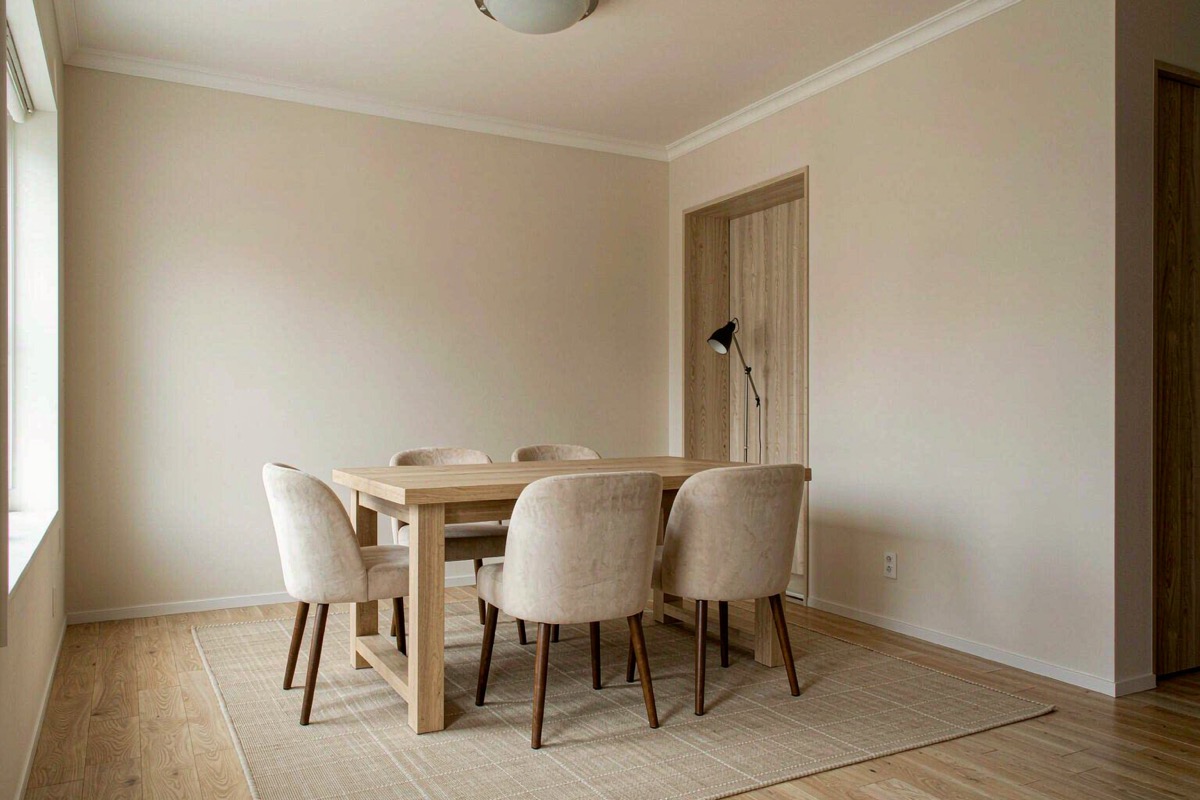
Every home has one room that defeats standard rug sizes: the hallway that
is neither eight nor ten feet, the dining set that needs every chair on
the rug, the alcove nothing off the shelf fits. Custom exists for exactly
that problem, but a custom rug is not one purchase — it is a sequence of
four decisions, each of which can quietly compromise the next. Get the
order of operations right and the process is straightforward; skip a step
and the rug still arrives, exactly the size of the mistake.
Decision one: the layout rules come before the tape measure
The most common custom-rug error is not a bad measurement — it is a good
measurement of the wrong target. Sizing rules are room-type rules, and
they determine what the number even means. In a living room, convention
is front legs of all seating on the rug, which sets a minimum dimension
larger than the furniture footprint. In a dining room, the rule is
non-negotiable: every chair, pushed back, stays on the rug, which adds
roughly two feet to the table's dimensions in each direction. In a
hallway, the runner should leave a visible margin of floor on both sides.
Only after the rule does the tape measure matter, and then it matters at
precision. Custom makers cut to the quarter inch, which is a genuine
specification rather than marketing: at that tolerance, a rug fits a
defined zone the way a fitted sheet fits a mattress. Door swing clearance,
radiator overhang and baseboard lips all eat into the number, and a
quarter-inch process has no forgiveness for any of them. Measure the
space twice, at different times of day if sunlight and radiant heat move
the materials, and write down the smallest honest figure.
Decision two: fiber, chosen by room physics
Fiber choice in the custom market is mostly a choice between wool and
synthetic, and the physics are simple to state. Wool is resilient,
naturally soil-resistant and takes deep dye — it is the heirloom fiber,
and custom wool lines from makers like The Perfect Rug are the showpiece
tier for living rooms meant to keep their rugs for decades. Its costs are
price and moisture behavior: wool is absorbent, dries slowly, and asks for
prompt attention after spills.
Synthetic PET fiber — recycled polyester — inverts the trade. It is
hydrophobic, stain-resistant and low-maintenance, which makes it the
rational pick under dining tables and in houses where the traffic includes
dogs. Its costs are feel and longevity: PET does not have wool's spring,
and a low-pile synthetic will show its age sooner than a wool rug of the
same construction. Neither fiber is the better one; they answer different
questions, and the room — not the catalog photo — asks them.
Decision three: pile height, the spec with hidden consequences
Pile height is the least examined decision in custom rugs and the one with
the most knock-on effects. High pile feels plush and looks substantial,
but it raises three practical conflicts: a rug that clears a door by
hair, a vacuum that struggles, and chair legs that rock in deep pile every time someone leans back at the dining table.
Low pile — a few millimeters
— solves all three, sits flat under doors, and makes chair drag trivial.
It also shows dimensional imperfections more honestly, because a thin rug
cannot hide a floor that is not level.
The interaction with fiber matters too. Low-pile wool reads crisp and
tailored; low-pile synthetic reads utilitarian, which is precisely why it
works in a dining room and looks out of place in a formal one. High-pile
synthetic tries to imitate plushness without wool's resilience and tends
to mat in traffic lanes — the combination to be skeptical of.
Decision four: the edge, where structure meets style
Binding is structural before it is decorative. A cut edge is a bundle of
loose yarn ends that will shed and unravel without protection, and the
binding method is what converts a cut piece into a finished rug. Serging
wraps the edge in yarn matched to the field — the quiet option, nearly
invisible, appropriate when the rug's own color is the statement. Fabric
binding applies a woven band along the edge, which adds a second layer of
wear protection and gives the rug a frame; custom makers offer it in
dozens of colors, and on long runners and dining-room rugs the bound edge
is doing real structural work at the points of heaviest abrasion.
The edge decision is also where color risk hides. A binding color chosen
from a screen against a field color chosen from a different screen is two
unverified assumptions stacked. This is the step where samples stop being
a courtesy and become the process: order swatches of the field material
and the binding, live with them against the actual floor and the actual
light for a few days, and only then commit. Color drift from website
rendering is one of the most consistent complaints in the custom-rug
category, and samples are its only real cure.
The process, and why made-to-order changes the rules
A custom rug is manufactured, not picked: dimensions entered, materials
cut and finished to spec, typically around fifteen business days of
production plus shipping, with owner reports of waits approaching six
weeks. The structural consequence is the return policy — a rug made to
your numbers cannot go back to stock, so custom orders are final sale,
with defects covered but miscalculation not. Everything above — layout
rules first, then measuring, fiber, pile, binding, samples — is the
sequence that makes a no-returns policy irrelevant instead of dangerous.
The checks, in order: confirm the room-type sizing rule and write the
target dimensions down. Measure twice and enter the smaller number. Choose
fiber by room physics — wool for longevity and depth, PET for mess
tolerance. Match pile height to doors, vacuums and chairs. Pick an edge
that protects as well as it looks. Order samples and wait for them.
Makers such as The Perfect Rug exist to execute that list to the quarter
inch; the list itself is the part that has to be right first.