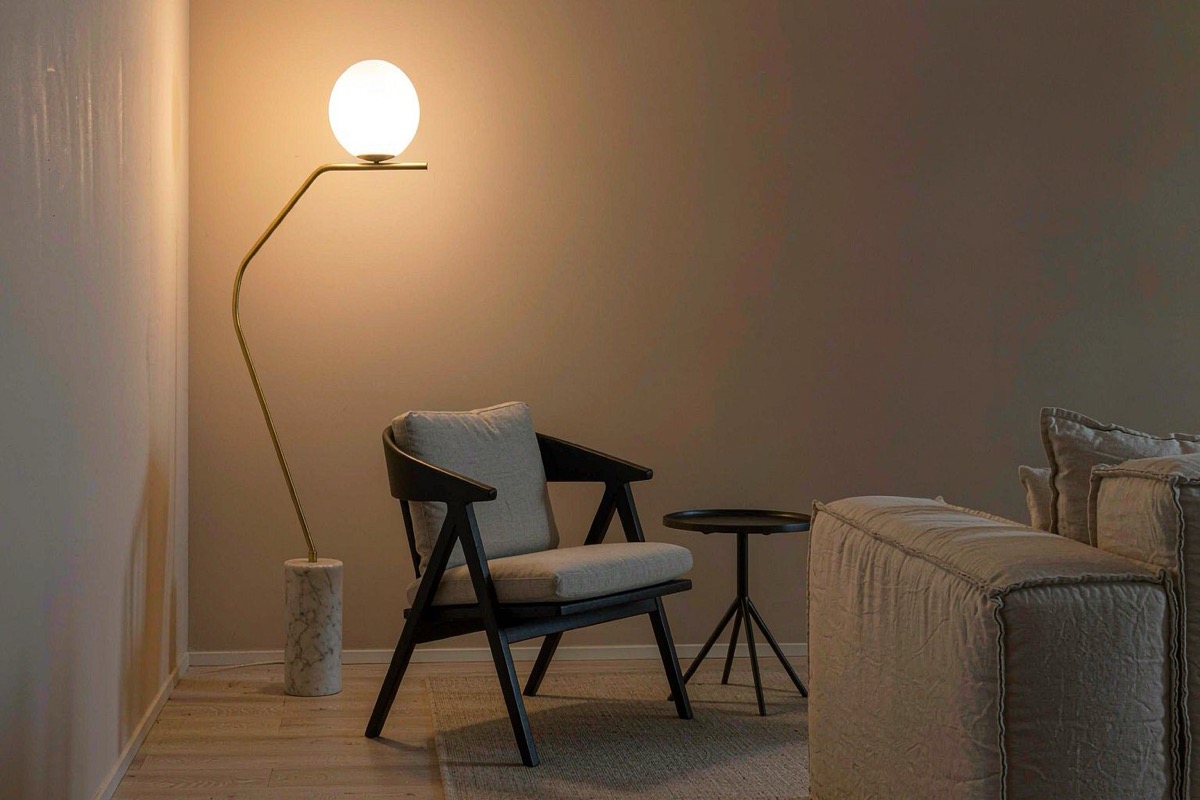
A designer lamp costs five to twenty times what a commodity lamp costs, and
the gap gets explained with words like heritage and vision. Those words are
not lies, exactly, but they hide the three places where the money physically
goes: the electronics that drive the LED, the dimming circuit that shapes
its output, and the materials work on everything you touch. Understanding
those three lets you judge any premium lamp on its merits — and lets you
spot the pieces where the premium buys nothing but the label.
The driver: the part you never see
Every LED lamp contains a driver — a small circuit that converts household
AC into the low, regulated DC an LED needs. It is the closest thing the
lamp has to an engine, and it is the first place quality diverges.
A cheap driver flickers. Not always visibly: at low refresh rates the
flicker registers as eye fatigue and headaches during long evenings rather
than as an obvious strobe. A good driver regulates current smoothly, holds
the LED at a stable temperature, and dies gracefully years from now instead
of taking the lamp with it. Driver quality is also why some lamps buzz on
a dimmer while others stay silent — the noise is the driver fighting the
wall dimmer's signal, and better-engineered lamps solve it at the circuit
level.
There is no badge for driver quality, which is why spec sheets matter: look
for flicker-free certification, stated PWM frequency above 3kHz, and
warranties long enough that the manufacturer expects the electronics to
last. A five-year warranty on a lamp implies a driver the maker trusts; a
90-day warranty implies one it does not.
The dimming curve: why some lamps feel expensive before they are on
Dimming is where engineering taste becomes visible. Human eyes perceive
brightness logarithmically — a light has to lose most of its output before
it looks half as bright. Cheap lamps ignore this and dim linearly, so the
bottom half of the slider does almost nothing useful and the low end
snaps to dark. Better lamps implement logarithmic or gamma-corrected
curves, and the difference is felt within a second of touching the switch.
Portables make the contrast sharper. The FLOS Bellhop, designed by Edward
Barber and Jay Osgerby in 2018 for the London Design Museum, dimming in
four defined steps from a 24-hour battery charged over USB-C, is the
step-curve approach: fewer choices, each one deliberate. Its owner record
at Lumens sits at 4.1 out of 5 across 17 reviews, with the battery
complaints — drain while off, occasional early failures — clustering
around the electronics rather than the light. That pattern is the point:
in portable lamps, the battery and driver are the engineering, and the
shade is the styling.
Materials: glass, marble and the honesty of weight
The third premium is materials work, and lighting is unusually honest about
it because light exposes every flaw.
Hand-blown opaline glass is the classic case. Blowing a globe by hand
yields wall thickness that pressed glass cannot match, and uniform
thickness is what makes the surface read as an even, sourceless glow. Acid
etching the surface scatters light one more time and kills the specular
glare of a bare bulb. FLOS's Glo-Ball series — Jasper Morrison's design,
hand-blown and acid-etched in Italy since the company's early decades in
Merano — is the textbook example, and across four sizes priced roughly
$252 to $840 it holds the softest light in its catalog's class. Weight is
the tell you can check in person: quality glass and quality metals are
heavier than imitations, and that heuristic extends to bases.
Which brings the discussion to load-bearing materials. The Arco floor lamp
— in continuous production since 1962 — throws a pendant's worth of light
seven feet from its base because the base is a Carrara marble block of
about 64 kilograms. The physics is not decorative: a cantilevered arch
stands only if the counterweight does its job. It is also the reason the
counterfeit Arco market is a safety issue rather than a snobbery one —
knock-offs substitute lighter bases that can genuinely tip, on a lamp that
puts a metal arch at head height in a hallway. Owner ratings for the
original run 4.9 out of 5 across 21 reviews at Lumens, with decades-old
units still in daily service, which is what continuous production and
quality materials compound into.
Finish quality is the visible half of the materials premium, and it has
its own checklist. Powder coating on metalwork resists chipping better
than spray paint because it is baked on as a solid film; brushed and
polished metals should be plated thickly enough that fingerprints wipe
off without wearing through to the base metal within a year. Machined
joints and weighted pulls are the small tells — parts that slide on
precision bearings versus castings that rattle in their sockets. None of
these show up in a photograph, which is precisely why finish work is
where discount imitations economize: the camera cannot weigh a hinge.
What the premium does not buy
Honesty requires the other column. Logistics scale with ambition: a marble
base ships by freight, assembly instructions for iconic pieces are
famously minimal, and a seven-foot arch sways enough that a busy hallway
is the wrong room for it. Electronic portables age faster than glass and
steel — batteries are consumables no matter whose logo is on the base.
And finish quality, while generally excellent at the top tier, varies by
collection; new experimental pieces lack the decades of production
refinement that the icons carry. A premium is a bet on a specific object,
not a category-wide guarantee.
How to judge any premium lamp in five minutes
Four checks do most of the work, and none require expertise.
Weigh it. Density is expensive to fake; hollow imitations feel hollow.
Watch it dim. Take the dimmer from full to low and back — a smooth,
flicker-free sweep across the whole range means the driver and curve are
engineered; stutter, buzz or a dead bottom range means they are not.
Read the warranty as a confidence statement about internal electronics.
And ask who makes replacement parts available, because a lamp worth a
premium is a lamp someone expects to repair — the continuous-production
icons are supported that way, and trend pieces usually are not.
If a lamp passes all four, the premium is buying engineering and it will
still be working in twenty years. If it fails the dimming check, the
premium is buying a shape — and shapes photograph better than they
behave.