What Makes a Bedside Lamp Actually Usable at Night?
Nine bedside lamps compared on reading light, pre-sleep glow, and switch reach. Three stand out for night use, according to owner reviews and spec sheets.
Maya Ellis
Lighting Editor
Last updated:
Nine bedside lamps compared on reading light, pre-sleep glow, and switch reach. Three stand out for night use, according to owner reviews and spec sheets.
Maya Ellis
Lighting Editor
Last updated:
Spec box
The figures behind each item are in the guide below, with the source named.
Some links here are affiliate links — purchases may earn us a commission at no extra cost to you.
Touch control anywhere on the base; lowest level sits in pre-sleep glow territory, per owner reviews.
$47 suggested
Narrowest base of the three picks; middle dim level works well for reading.
$23 suggested
Rotary knob runs from 10% to full; USB-A, USB-C and an outlet in the base.
$20 suggested
A bedside lamp has two jobs that pull against each other: bright enough to read by at 10 p.m., dim enough that 2 a.m. doesn't feel like an interrogation. Most lamps do one and fake the other. Comparing specs, professional reviews and owner feedback across nine candidates, three handle both. The sections below explain what to check before you buy — and the one spec almost every listing buries.
Four questions decided which lamps made this list, and all four are best answered from bed, not from the showroom floor:
The two-state question does most of the filtering. Plenty of lamps claim "3-way dimming" and then land their lowest step at what feels like half brightness in a dark room — a reading light you can't turn down is a nightlight you can't read by, and it fails at both of its jobs. Switch reach is the quieter killer: a lamp with perfect dimming that lives across the nightstand gets unplugged within a month, because nobody sits up at 1 a.m. just to switch it off.
Strip every listing down and two numbers carry nearly all the night-use signal.
The dimming floor. Not the range, not the number of steps — the level of the lowest setting. A 3-step lamp whose low sits at 30% output is a worse night lamp than a 2-step lamp whose low sits at 10%. This is why the Intebee below earns its spot on the strength of a "10% floor" spec, and why the Fenmzee's owner reviews mention a lowest setting brighter than expected. When a listing doesn't state the floor, owner reviews will: search them for "nightlight" and "too bright."
Base diameter. Real nightstands are 16 to 20 inches wide and already occupied. The lamps here run 4.5 to 6 inches across their bases, which leaves room for a book, a glass of water, and a phone. A lamp is one of three or four objects on that surface; anything that demands more than a quarter of the real estate will get moved to the floor, and a lamp on the floor has a switch-reach problem no dimmer can fix.
Everything else in a listing — shade fabric, cord length, the lifestyle photo with the fake plant — matters less than these two. Shade material can actually matter for glare, but only after the floor and footprint are right.
| Lamp | Switch | Base diameter | Dimming | Price | | --- | --- | --- | --- | --- | | Wade Logan Burdena Touch Control Table Lamp | Touch, 3 levels | 6 in | 3-step | $47 | | Fenmzee Bedside Table Lamp | Touch, 3 levels | 5.5 in | 3-step | $23 | | Intebee Dimmable Bedside Table Lamp | Rotary knob on base | 6 in | Continuous (10% floor) | $20 |
Read the dimming column with the floor in mind: the Intebee's continuous range is a different dimension of control than the other two's fixed steps. Whether you need that precision is most of what the decision comes down to.
Three touch levels, and the lowest one sits in genuine pre-sleep glow territory — warm enough that it won't wake a partner, per the buyers who use it exactly that way. That low setting is the hardest thing to engineer in a budget lamp and the easiest thing to get wrong; the Burdena gets it right, and its owner feedback reflects it.
Touch control anywhere on the metal base means no hunting in the dark, and the built-in USB port earns its keep. The phone charges at the nightstand regardless of which lamp you buy — the difference is whether the lamp's own outlet requirement and the charger's fight over one wall socket. Wayfair shoppers rate it 4.8 stars across several hundred reviews; the recurring praise is the touch control and compact footprint, and the recurring gripe is touch sensitivity. That gripe is worth reading closely: "too sensitive" means the lamp answers an accidental brush — annoying at 2 p.m., almost funny at 2 a.m., and never a reason to get out of bed.
It's the most expensive pick here, but the rating is consistent enough to justify it.
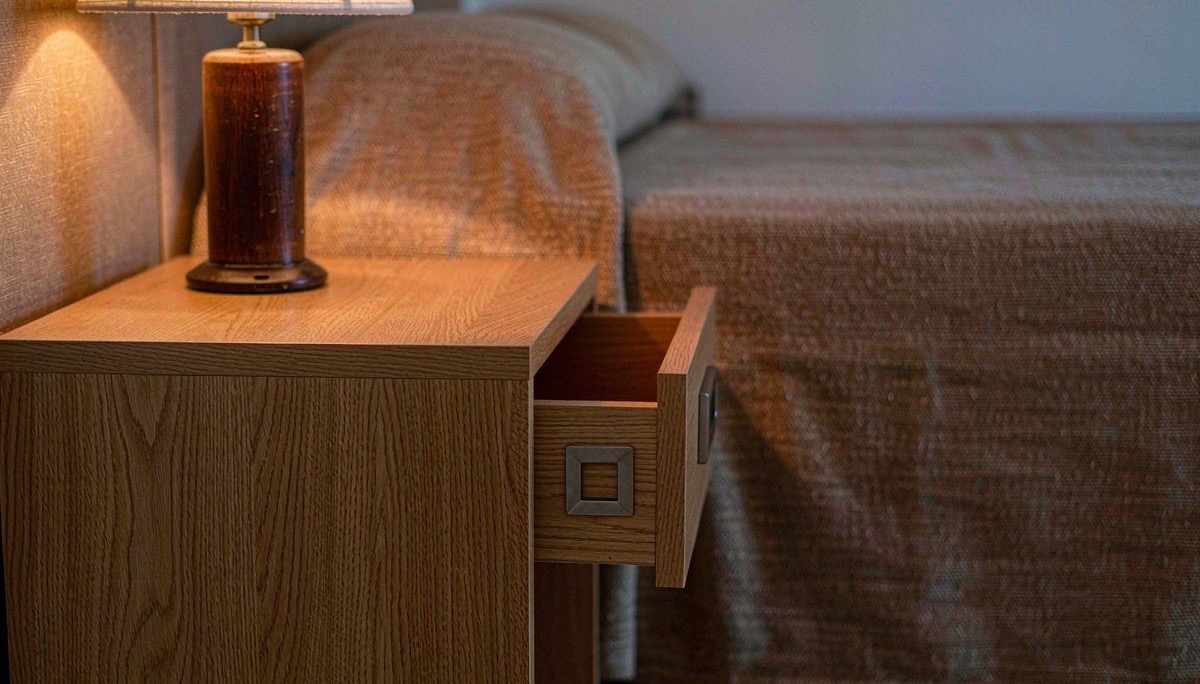
The target: a lamp low enough to read by, warm enough to sleep around.
A narrow wooden base around 4.5 inches across, which suits smaller nightstands. This is the pick for the nightstand that is already losing the battle against a water carafe and a paperback — the footprint leaves the surface usable, which no other lamp here matches at any price.
The touch control sits right on the base — reachable from bed without sitting up — and the included warm-white bulb means it works out of the box. That last part is underrated: half of the bedside-lamp listings around $20 ship without a bulb, and the true price of the others is the bulb you add. Owners consistently single out the responsive 3-step touch dimming and the USB-C/ USB-A/outlet charging trio, and with well over 700 Amazon ratings averaging 4.5 stars, the pattern holds across a large sample.
The most common complaints are an over-eager touch sensor and a lowest setting that's brighter than some expect for a nightlight. The 3-step dimming is coarser than the knob pick's continuous range, but the middle level happens to be a good reading brightness — which means the Fenmzee's steps line up with its actual uses instead of spreading arbitrarily.
Continuous rotary dimming from 10% to full for $20, with USB-A and USB-C ports and an outlet built into the base. On raw specs it beats everything else here: three charging options, the widest dimming range, the lowest price. If the lamp you're replacing died because its "low" was too bright for falling asleep, this is the direct fix.
The caveat is the knob. A rotary switch asks more of a half-asleep hand than a touch base does — you have to find it, then turn it to the right position rather than tapping anywhere on the base. And its floor sits a step brighter than the touch picks' lowest setting, so the continuous range buys precision in the middle of the dial more than darkness at the bottom.
Learn the knob and it's the value pick by a wide margin. Muscle memory forms within a week; the question is whether you'll give it that week.
Beyond the two specs above, four details separate a lamp you keep from one you return.
Look for what ships in the box. "Bulb included" is a $10 swing in true price and a guarantee the lamp was at least tested lit. Look at the switch location — "touch control on base" tells you reach is solved; "in-line switch on cord" means the switch lives wherever the cord does, often on the floor. Look at whether the dimming is described in steps or percentages: steps mean preset levels, percentages mean continuous, and the difference shows up every single night. And read the negative reviews specifically for "too bright on low" — that one phrase is the single best predictor of night-use regret, and it appears in every lamp's reviews if it's true.
Prices this low ($20 to $47) make returns cheap, which is an argument for buying your first choice and testing it from an actual pillow rather than researching for another weekend.
Whatever lamp you buy, the bulb inside does as much for night use as the lamp's own dimming. Three things worth knowing before you swap anything.
Color temperature first. Warm white — 2700K and below — is the range that reads as evening light; anything labeled "daylight" (5000K and up) will feel clinical at midnight no matter how well it's dimmed. Our best warm smart bulbs guide covers bulbs that can do the warming and dimming themselves, which is one fix for a lamp whose steps you don't love.
Brightness second. A bedside reading lamp needs enough output to read by — roughly the output of a 40- to 60-watt incandescent — but the value of a dimmable lamp is that you buy the headroom and use only what the moment needs. If the lowest setting is still too bright, a lower-output bulb moves the whole range down.
One electrical note: if your lamp dims with a rotary knob, the bulb needs to be a dimmable model or you'll get flicker and buzz. Touch lamps handle dimming internally, so the bulb choice only sets the top end. Either way, the pairing of lamp and bulb is the real product — the listing just sells half of it.
Touch control is the right default for most nightstands, but two situations argue for the knob.
If you share the bed with a dog or a child who treats the nightstand as territory, a lamp that answers any contact will live at full brightness more often than its owner expects. The Intebee's knob ignores paws. The second case is deliberate switching: some people want the light on before their head hits the pillow and off without ambivalence — a rotary control has a defined off position, while a touch lamp's "off" is one more tap among the steps it cycles through, and cycling through brightness levels to reach darkness is a small thing that some sleepers never stop noticing.
Everyone else should buy the touch lamp. Half-asleep hands are bad at knobs and good at tapping.
Prioritize the low end of the dimming range over the top — nobody needs 800 lumens at midnight, but everyone needs 15. Then put your hand where the switch will be before you buy: the difference between a lamp you use nightly and one you unplug is often just reach.
Within this lineup that logic points at the Burdena for most buyers: the lowest light of the three, touch control that survives a half-asleep tap, and a track record across several hundred reviews that mentions neither flicker nor failure. Pay $47 once instead of $20 twice.
| Lamp | Switch | Base diameter | Dimming | Price |
|---|---|---|---|---|
| Wade Logan Burdena Touch Control Table Lamp | Touch, 3 levels | 6 in | 3-step | $47 |
| Fenmzee Bedside Table Lamp | Touch, 3 levels | 5.5 in | 3-step | $23 |
| Intebee Dimmable Bedside Table Lamp | Rotary knob on base | 6 in | Continuous (10% floor) | $20 |
Sofia Lund
Editor-in-Chief & Kitchen / Dining
How Ceramic Coatings Die: Abrasion, Thermal Shock and the 18-Month Curve
Daniel Hart
Furniture / Bedroom
Why Bed Frames Squeak — and Which Design Decisions Keep Them Quiet
Maya Ellis
Lighting
Why Your Dimmer Buzzes: Flicker, Load and Picky LED Fixtures
Updated October 10, 2026 · Maya Ellis
Updated October 9, 2026 · Maya Ellis