The most-used knife in a kitchen does the least impressive cutting.
It is the paring knife, or the peeler, or the grater — the tools that
show up every single day, in repetitive motions, for decades. That
repetition is the whole engineering case for taking hand tools
seriously: a tool you use twice a year can afford to be badly
designed, but a tool that makes forty wrist motions per salad turns
every flaw in its geometry into a tax collected daily. Kitchen-tool
ergonomics is the study of that tax — how much force a design makes
your hand spend, through what joints, repeated how many times — and
the brands that have thought about it longest show it in details most
listings never mention. Zyliss is the instructive case: a Swiss
food-prep specialist founded in 1951 by inventor Karl Zysset, whose
workshop famously turned a bicycle brake into the world's first
garlic press, and whose catalog still reads like a course in force
management.
The peeler: blade geometry as labor savings
A peeler's entire job is to make sure the hand never does the
cutting's work — the blade should. Two design decisions decide
whether it does. First, swivel versus fixed blade: a swivel head
pivots on a pin so the edge tracks the curvature of a carrot or
potato without the wrist correcting course, which converts a
constant micro-adjustment problem into a straight pull. Second,
blade exposure and angle: a shallow, sharply set edge slices peel
with the weight of the hand, while a steep or dull geometry makes
the user press the potato into the blade, which is where hand
fatigue and knuckle nicks both begin. Add the handle question —
grip diameter that fills the palm versus the pencil-thin stainless
stems that concentrate all that daily force into a finger
pinch — and the peeler aisle sorts itself into engineering and
decoration. The Y-shaped ergonomic handles that look like marketing
are actually a second-order effect: they hold the wrist in a
neutral, handshake position through the stroke, which matters most
at the repetition rates a weeknight dinner actually produces.
The press: lever class, in your hand
A garlic press is a class-two lever wearing a kitchen apron. The
cavity is the load, the plunger pushes it against a perforated
plate, and the mechanical advantage comes from the distance between
your grip and the pivot: longer handles buy more crushing force per
squeezed pound, which is why the flimsy short-handled presses ask
your palm to supply what their geometry refused to. The second
variable is fit — how closely the plunger meets the hopper and how
the holes are patterned. A tight fit with a matched hole grid
extrudes cleanly; a sloppy fit lets cloves smear sideways into the
clearance gap, which doubles the force and leaves half the garlic
unpressed. Zyliss's founding Susi press made its name on exactly
this arithmetic, and the mechanism's modern descendants inherit the
lesson: ergonomics here is not rubber grips, it is lever ratios.
The unsung third variable is cleanability — a press with a hinged
basket that rinses clear under the tap gets used daily, while one
with garlic welded into a crevice migrates to the back of the
drawer within a month. For a daily tool, time spent cleaning is
ergonomic cost just as surely as force spent squeezing.
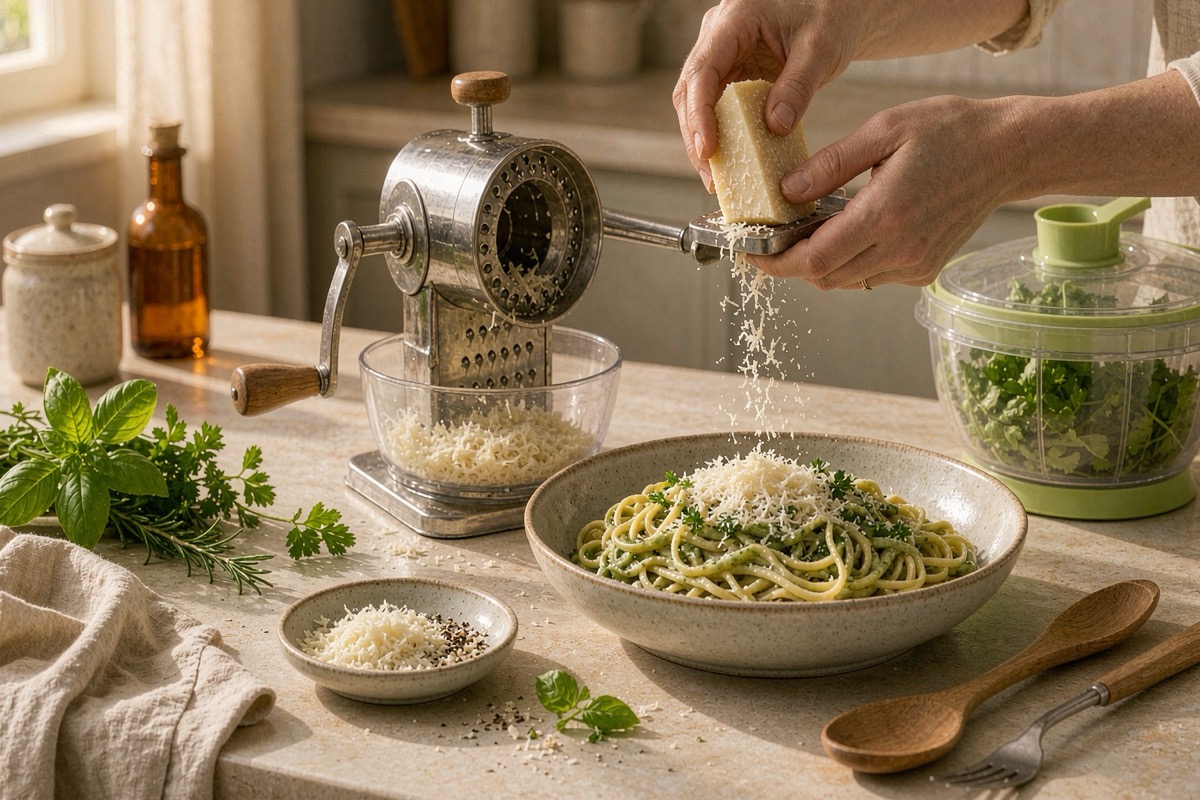
The grater: push versus crank
Box graters and rotary graters grate the same cheese with opposite
biomechanics. The box grater makes the food move across a fixed
blade: repeated downward strokes, wrist flexion doing the work,
fingers tracking toward sharp holes as the block shrinks. The
rotary grater fixes the food in a hopper and makes a geared drum
move instead — a crank arm converting steady forearm rotation into
cutting speed at the drum surface. The design trades are explicit.
One drum means one texture, and soft cheeses clog the holes where a
box grater's open face shrugs them off; the clearance channel
between drum and housing traps shreds that need a brush. But for
hard cheese at volume, the crank wins on every axis that matters
to a hand: fingers never approach the blade, the force is steady
instead of percussive, and the throughput is genuinely fast —
America's Test Kitchen's side-by-side testing of rotary graters
crowned Zyliss's Classic model, which grated an ounce of Parmesan
in 23.3 seconds, faster than everything else they tried, while
folding flat for drawer storage and carrying NSF restaurant
certification. Owner ratings land at 4.4 stars, and the detail
worth copying into any buying decision is the ambidextrous crank,
which swaps between left and right hands so the fatigue is shared
rather than charged to one forearm.
The spinner: angular speed and the failure you can design around
A salad spinner is applied physics: water clings to leaves, and
rotation outruns that cling, flinging water off while the basket
holds the greens. Designs differ in how they buy angular speed. A
pull-cord mechanism — the type in Zyliss's Easy Spin, which scored
4.31 of 5 in mybest's twelve-spinner comparison and averages 4.3
stars with buyers — builds speed in one strong pull rather than a
pumping motion, runs quieter than a crank, and adds two
conveniences that are ergonomic rather than cosmetic: a spout that
drains the bowl without lifting the lid, and a brake that stops
the basket instantly. The instructive flaw is the one long-term
owners report: the inner disk's plastic clips loosen over months
of use and can let the disk separate from the lid. That is fatigue
in the engineering sense — a small plastic part asked to absorb
stress thousands of times — and it is a reminder that ergonomics
extends past the hand to durability under repetition. A 5-year
warranty on a $37 tool is a manufacturer's answer to exactly that
failure mode, and one worth checking on any tool intended for
nightly duty.
Force times repetition is the whole spec
Reduce the category to one equation and it is this: ergonomic cost
equals force per use, times uses, across years. A tool that asks
twenty percent less force per motion repays that margin at every
salad, every pasta night, every garlic-heavy recipe — and the
repayment compounds into the difference between a tool that lives
by the stove and one that lives in the drawer. Read hand tools the
way the specialists do: where does the force come from, through
which joint, how many times, and what part wears out first. The
answers, not the packaging, decide whether a peeler, press or
grater actually works.