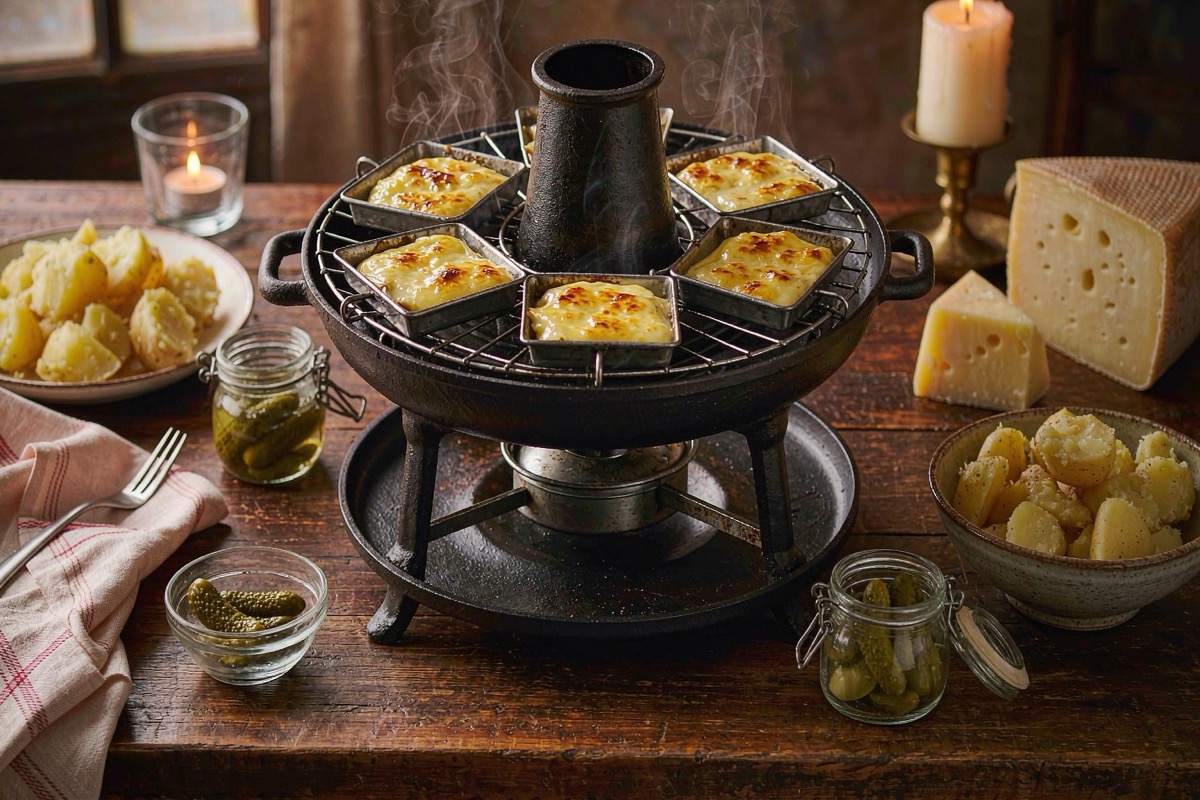
Melted cheese is one of the oldest cooked foods in Europe, and it is
also one of the easiest to ruin at home, because both of its classic
table formats — raclette and fondue — are heat-management problems
disguised as parties. The cheese itself is fragile chemistry: push it
ten or twenty degrees past its working range and a smooth, glossy
melt turns into a broken, oily mess that no amount of stirring fully
recovers. Understanding what the heat is doing, where it comes from,
and how the table should be arranged separates a dinner that runs for
hours from one that congeals by the second round. Swissmar, the brand
that has specialized in exactly this equipment for over thirty years,
makes a useful reference case, since its two flagship formats embody
the two different heat philosophies.
First, the cheese: what melting actually is
Cheese is a network of casein proteins trapping fat and water. Melting
means that network loosening enough for the fat to flow and the whole
mass to slump; the melt quality depends on three variables. Moisture
is the big one — young, high-moisture cheeses melt smoothly because
there is enough water to keep the proteins lubricated, while hard,
long-aged cheeses have lost that water, so their fat renders out and
pools instead of emulsifying. Age also tightens the protein network
itself, which is why a twelve-month wheel goes greasy where a
three-month wheel goes silky. Salt and calcium content modulate the
same effect.
Raclette cheese sits in the sweet spot: a semi-hard, high-moisture,
gently aged wheel that begins to flow around 130 to 150 degrees
Fahrenheit. Fondue solves the problem differently — it makes an
emulsion on purpose. The traditional Alpine recipe grates two cheeses
for balance of flavor and melt, adds wine whose acidity keeps the
casein from clumping, and suspends a spoonful of cornstarch in the
mixture so the emulsion holds through a long dinner. The cornstarch
is not a garnish; it is structural engineering at the molecular
scale, and leaving it out is why some homemade fondues break in the
first twenty minutes.
Raclette: radiant heat from above, broiling from below
A raclette grill is a two-zone heat machine. On top, a flat or
ridged plate cooks directly — crepes, vegetables, meats — over an
electric element with variable control; a typical eight-person unit
draws around 1,200 watts. Below that plate sits the format's real
trick: a row of small trays, one per guest, positioned under the
element's underside so the cheese in each tray broils — melted from
the top down by radiant heat, not boiled from the pan. Each guest
scrapes their tray over a plate when the cheese reaches the flowing,
bubbled stage, which takes several minutes per round, then loads the
next round and talks while it works.
That pace is the format's design, not a flaw: the appliance is a
conversation device that happens to cook. The Classic 8-person
raclette, the model most competitors get measured against, has
accumulated a 4.6-star average across nearly 2,700 Amazon ratings
since 2001 — two decades of the same formula, a reversible cast
aluminum plate with eight trays and spatulas included. Two practical
notes recur in owner reports and both are heat-related: the nonstick
tray surfaces want soft utensils, and a fully loaded plate takes a
few minutes to recover temperature between rounds, which argues for
a heat setting held steady rather than maxed and cycled.
Fondue: conduction and held temperature
Fondue inverts the geometry. The cheese is melted once, in a pot,
before service — traditionally started on the stovetop where the heat
is strong and controllable — then moved to the table, where the only
job of the burner is to hold the emulsion at serving temperature
without pushing it into the range where it breaks. That hold is
harder than it sounds: the pot must deliver gentle, even heat for
hours. Enamelled cast iron is the classic material precisely because
it stores heat and releases it slowly, so the burner's flicker does
not become the cheese's temperature swing. Fuel-burner sets, like
the Lugano class of two-quart cast iron pots on a wrought-iron
rechaud, run on gel fuel canisters — budget roughly one canister per
evening — while electric bases trade the flame for a thermostat,
which is easier to hold but adds a cord to the table. The cast-iron
format holds a 4.7-star average across roughly 900 ratings, among
the category's best, and its caveats are textbook: two hands for
the pot on the move, and patience with a flame that punishes
impudence in soot.
Setting the table for both
The setup follows the heat sources. Electric units want a direct
wall outlet on a circuit that is not already feeding the kettle — a
1,200-watt grill draws around 10 amps, and an overloaded circuit on
dinner night is a tripped breaker waiting for guests. Gel burners
want clearance: the flame sits below the pot at lap height, so
nothing flammable, no sleeve, no centerpiece garland, within reach,
and a snuffer or the burner's cap within arm's length. Both formats
want the unit off the table edge, cords routed away from chairs,
and a trivet ready for the stovetop-to-table move.
Then arrange for the format's rhythm. Raclette is a rotating relay:
grill food and melt trays in overlapping rounds, keep cold sides —
pickles, potatoes, cured meat — in the middle so nobody waits, and
give the eight spatulas a home. Fondue is a shared pot with fork
etiquette: the long forks cook the bread, a dinner fork eats it,
and the pot's temperature knob stays low enough that the cheese
moves like syrup, not like a simmer. If the surface under the
cheese layer starts to brown, the heat is too high — lift the pot
off the burner for a minute, stir from the bottom, and it recovers.
One principle under both formats
Raclette and fondue are the same idea executed from opposite
directions: deliver heat to cheese gently enough that its emulsion
holds, for long enough that a table can gather around it. Raclette
spreads the heat across eight small trays and lets the table self-
serve in rounds; fondue concentrates it in one pot and asks the
burner to hold steady for hours. Choose the format by how the
evening works — many hands and moving parts point to the grill,
fewer people and slower hours point to the pot — and the equipment
follows from the physics. The cheese, given the right range of
temperature, takes care of the rest.