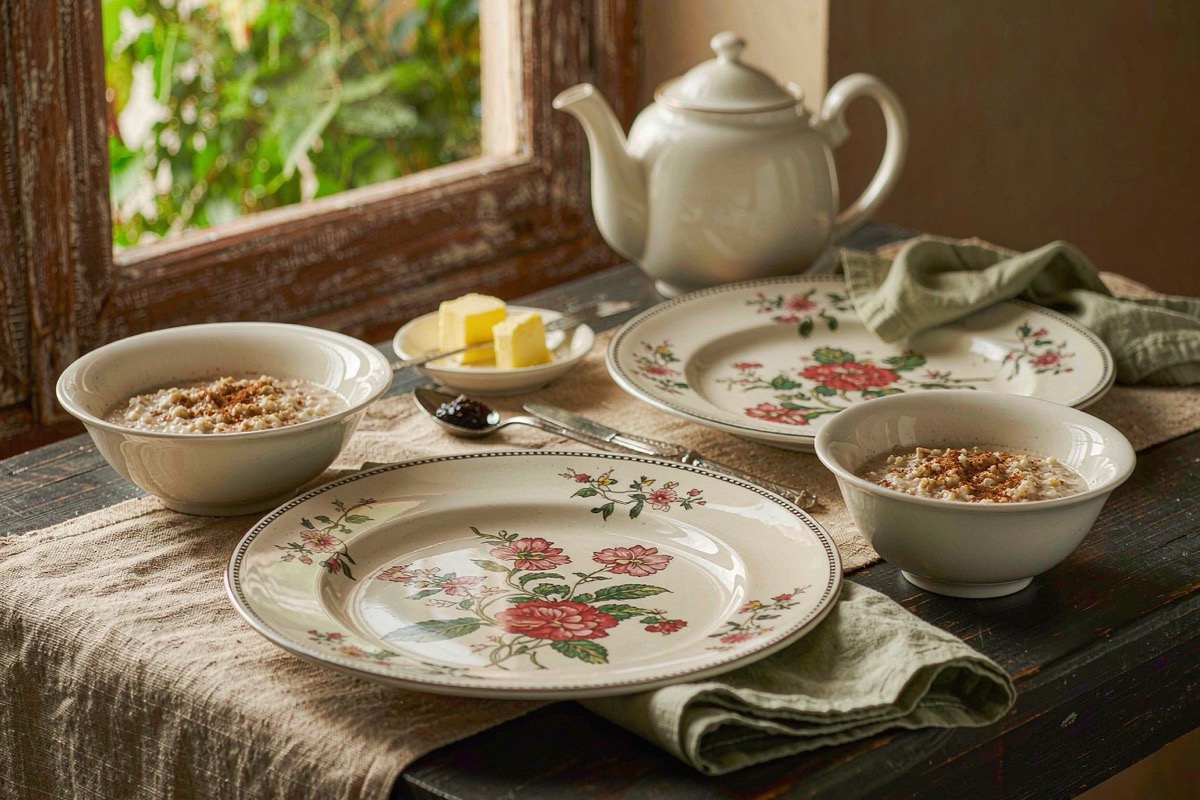
The fastest way to learn what a dinner plate is made of is to turn it
over. The front shows you a pattern; the base shows you a maker's mark, a
country, sometimes a body-type claim — and together with two tests that
take thirty seconds, that mark tells you what the plate actually is.
Most buyers never learn this, which is why "porcelain" gets used as a
generic word for anything white and glossy, and why genuinely different
materials get judged by the wrong standards.
The four bodies, separated by fire
Dinnerware bodies are defined by composition and firing temperature, and
the two variables move together. Earthenware is fired at the lowest
temperatures, which leaves the body porous and relatively soft; it must
be glazed to hold food and water at all. Stoneware fires hotter, dense
and opaque, with real chip resistance and the thick, substantial feel
people mean when they praise "hearty" plates. Porcelain fires hotter
still — kaolin-based clay at temperatures approaching vitrification —
producing a dense, non-porous, cool-white body. Bone china is porcelain
remade with bone ash: roughly half the body by traditional formulation is
calcined bone, fired to full vitrification, which produces the lightest,
strongest-per-millimeter and most translucent of all the bodies.
The counterintuitive fact is the strength ranking. Bone china sounds
delicate and is, by weight, the toughest of the group — hotelware buyers
know this — while thick stoneware earns its durability reputation from
mass rather than from material strength. Thickness and durability are
related but not identical, and the confusion costs buyers who reject a
light plate as fragile when it is, gram for gram, the best-built thing on
the shelf.
Three tests anyone can run
Translucency comes first: hold the plate edge-on to a strong light. Bone
china glows with a warm, creamy transmission; porcelain passes light
cooler and more grudgingly; stoneware and earthenware stay opaque. Rim
color is the second test, readable even without a light: bone china reads
warm white with a faint ivory cast, porcelain cool white with a faint
blue-gray cast. Side by side, the difference is obvious; from memory, it
is not — which is why the two tests work best together.
Weight and sound finish the identification. Bone china feels startlingly
light for its diameter; porcelain feels denser; stoneware feels like what
it is, mass. The ring test — a gentle tap with a fingernail — separates
vitrified bodies from porous ones: porcelain and bone china give a clear,
sustained ring, while earthenware answers with a duller thud, because
sound travels differently through dense glass-like material than through
a body with pores. A cracked piece of any body loses its ring, which
makes the tap a genuine inspection tool at flea markets and in inherited
boxes.
Two more signs sharpen the identification, and both show up at the edge.
Crazing — the fine web of cracks inside a glaze — appears on porous
bodies whose clay expands and contracts more than the glaze over them;
a network of hairline lines under the surface is strong evidence of
earthenware or old low-fired stoneware, not vitrified porcelain. Glaze
wear at the rim tells its own story: the rim is where glaze is thinnest
and abrasion heaviest, so a rim worn to bare clay marks decades of real
use, while an intact rim on a supposedly old piece deserves suspicion.
Weight distribution completes the picture. Vitrified bodies concentrate
their density evenly, so a porcelain plate balances with a flat, neutral
heft in the hand; earthenware of the same diameter feels hollow by
comparison even when the dimensions match. Neither feel is better —
they are simply the honest signature of what fired at what temperature,
and hands learn the difference faster than eyes do.
Reading the backstamp
The base marks follow conventions worth knowing. The maker's name is the
anchor; the pattern name usually appears beneath or beside it; and the
country of origin became a legal requirement on imports into the United
States in the 1890s, so its presence or absence is itself a dating tool.
Body-type claims are the most valuable line of all: in the United
Kingdom, a Bone China or Fine Bone China stamp is a regulated claim with
a defined bone-ash content behind it — a stamp with legal weight, not a
marketing word. Portmeirion's Botanic Garden pieces, made in Stoke-on-Trent
since the pattern launched in 1972, carry the classic English pottery
marks, and collectors use the small changes in mark design across decades
to date individual pieces.
Backstamps also encode honest material expectations. A mark reading
earthenware — as Botanic Garden's fine earthenware body effectively does
— tells you the plate is lighter and thinner-feeling than stoneware, that
its durability depends on glaze integrity, and that modern production is
dishwasher- and microwave-safe while genuinely old pieces may predate
those guarantees. Inherited dinnerware should be heated gently regardless
of what the current catalog promises, because the formulation on the shelf
today is not the formulation fired forty years ago.
Matching the body to the job
Each body has a job it is actually right for. Bone china is the formal
table's material: light enough to stack beautifully, strong enough for
daily service, expensive enough that most households reserve it. Porcelain
is the all-rounder — everyday elegance with real chip resistance and full
oven-to-table tolerance. Stoneware is the casual workhorse, trading
refinement for mass and thermal inertia; it is what "rustic" dinnerware
almost always is. Earthenware is the decorator's body: printed patterns
register beautifully on it, which is why floral lines have historically
chosen it, and its lighter feel suits people who dislike heavy plates —
with the honest trade that the glaze, not the body, carries the durability
burden.
The buying logic compresses to three questions, the same ones a dealer
would ask. What body is this, verified by stamp, translucency and rim
color rather than by the listing's adjectives. What is the use case —
daily, formal, outdoor, display — and does that body's physics match it.
And if the piece is old, what do the marks date it to, and has its care
standard changed since. Portmeirion's two-tier catalog illustrates the
whole system in one brand: the 1972 earthenware classic for pattern
loyalty, the porcelain line launched in 2006 for all-temperature modern
use — two different materials under one roof, each labeled, each right
for a different table. That is what reading the base of a plate buys
you: not connoisseurship, just the ability to know what you are actually
holding.