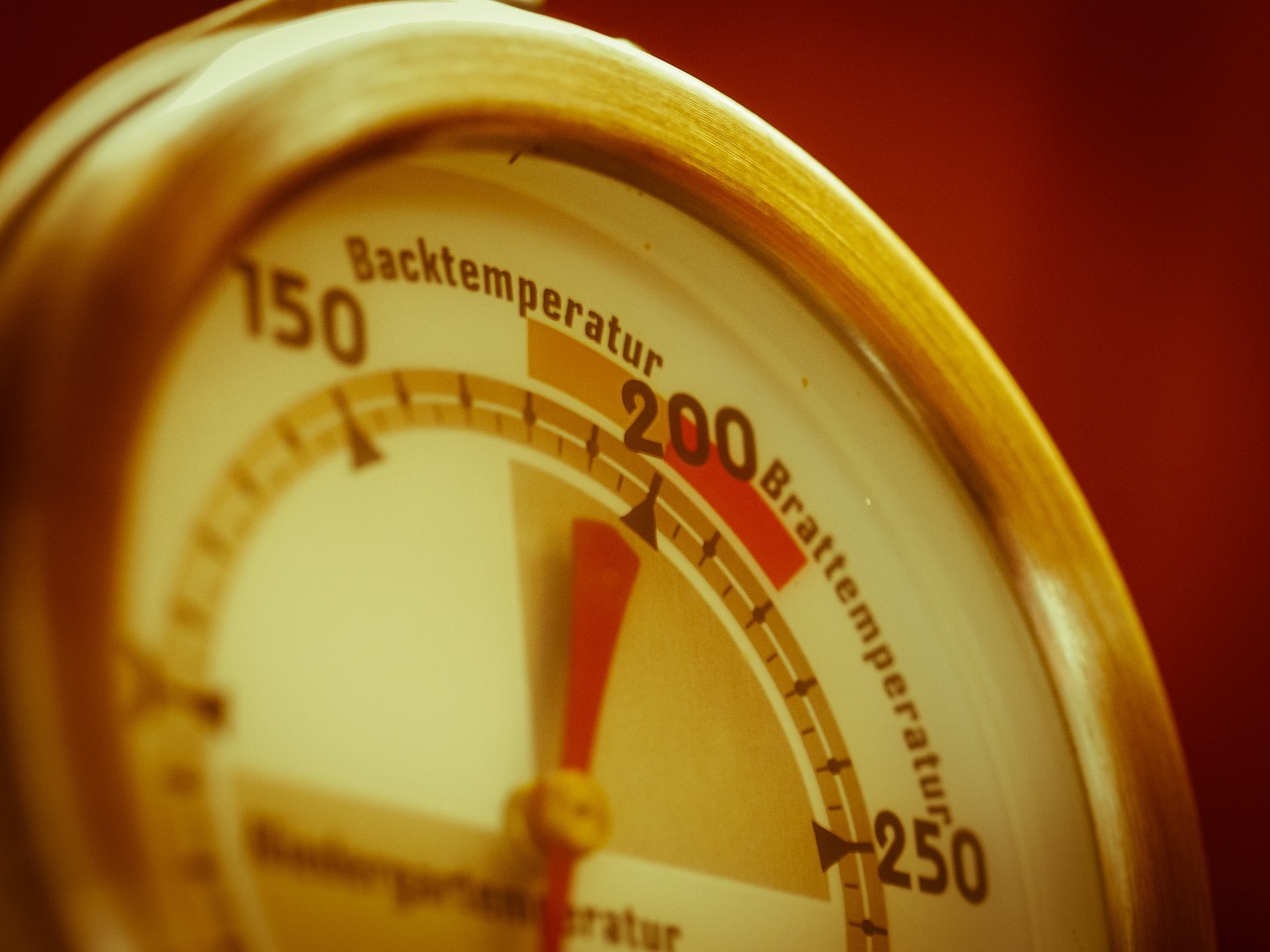
The number on the oven display is a request, not a reading. Every home oven
holds its setpoint by cycling a heating element on and off around a
thermostat, and the thermostat is a mechanical or electronic component with a
tolerance like any other. Consumer testing by America's Test Kitchen has
repeatedly put new ovens 25 degrees or more away from their setpoint, in both
directions. The recipe that says 375F was written for an oven holding 375F;
yours may be delivering 345 or 410, and the only way to know is to measure.
Judge it by the numbers: this is the cheapest instrument upgrade in the
kitchen, and the only one that fixes every recipe at once.
Why the gap exists
Four separate gaps stack between the dial and the air around your cake pan.
Thermostat tolerance. The sensor that decides when to fire the element
has a dead band, a range within which it does nothing, so the oven
deliberately overshoots and undershoots around the setpoint instead of
holding it flat. On a healthy oven this swing is 10 to 20 degrees; a worn or
miscalibrated thermostat widens it.
Element placement. Most ovens heat from the bottom, which means the air
near the floor of the cavity runs hottest and the air near the top rack
depends on convection to catch up. An oven that reads 375F on a thermometer
at the center rack can be running 25 degrees hotter at the bottom position,
which is exactly where most people put their baking sheets and why cookies
burn underneath while staying pale on top.
Preheat dishonesty. The preheat signal fires when the air near the
thermostat reaches the setpoint, often after a deliberate early burst of
element heat. The walls, racks, and floor of the cavity are still far
colder, and they absorb heat from everything you put in. Thirty minutes
after the beep, a dark, heavy oven interior may still be warming toward its
final temperature.
Door leakage. Every opening dumps a measurable share of the cavity heat
and forces a fresh element cycle, which is the widest single swing in the
whole system. The gasket around the door is a wear part; a torn or flattened
one leaks continuously, and the oven answers by firing more often, widening
the swing around the setpoint. A strip of paper caught in the closed door
and tugged — if it slides out with no resistance, the seal has stopped
gripping at that spot.
Building the map
An oven thermometer, a bimetal or dial type that sits inside the cavity,
costs under ten dollars. One oven, one hour, and the whole problem becomes
arithmetic:
- Hang or stand the thermometer at the center of the middle rack, the
position recipes assume, and set the oven to 350F.
- Wait until the preheat signal, then wait twenty more minutes for the
cavity walls to saturate. Write down the reading.
- Leave the oven at 350F for another thirty minutes, noting the reading
every ten minutes through the window. The lowest and highest numbers you
see are the cycle swing; the middle of that range is the oven's true
average at a 350F setpoint.
- Repeat at 425F, the common roasting setpoint. The offset is not always
uniform across the range, so two points are worth the extra twenty
minutes.
Suppose the map shows 365 average at a 350 setpoint and 445 average at 425.
The oven runs hot by roughly 15 to 20 degrees, consistently. Every recipe
you bake at a 350 setpoint is actually being baked at 365, and the fix is
either a calibration adjustment or the habit of setting the dial 15 degrees
lower than the recipe says.
Rack position is the second dial
The map describes one position only: the center of the middle rack. Element
placement already puts the hottest air near the cavity floor, so the bottom
rack position runs hotter than the center, and the top position cooks by
convection alone — gentler, but uneven. Moving a baking sheet from center to
bottom is effectively an invisible dial turned upward; the setpoint never
changed, but what the food experiences did.
The practical rule follows from the map. Default to the center rack, because
that is the position every recipe assumes. Drop to the bottom position when
you want stronger browning on a pan's underside. When two sheets have to
share the oven, swap their racks partway through so neither spends the whole
bake in the wrong zone. Racks are free to move; the thermostat is not.
Pans and modes that bend the numbers
The map is a baseline, and a few variables move your food around on it. Dark
metal pans absorb radiant heat faster than shiny ones, which is why cookies
on a dark sheet burn underneath at an unchanged setpoint — drop the rack one
position or shave the time rather than adjusting the dial. Glass bakeware
holds heat and keeps cooking after it leaves the cavity. Convection mode
adds a fan that moves hot air across the food, so the outside browns faster
than in a static oven; recipes written for conventional heat generally need
a lower setpoint or a shorter time in fan mode.
None of these change the map itself. They change where on the map a given
bake actually sits, which is exactly why a measured map beats a memorized
correction.
Fixing it
The cheap fix, done right, comes in three tiers.
Compensate first. The mapped offset is now a known constant. Write it on
a piece of tape inside a cabinet door: "runs +15 at 350." Adjust every
setpoint by that amount until further notice. This costs nothing and handles
the problem completely for most households.
Calibrate second. Many ovens expose a calibration offset: behind the
temperature knob, or in an electronic settings menu, adjustable in 5 to 10
degree increments. Pull the model's manual and search the index for
"calibration" or "offset"; on knob models it is sometimes a screw on the
back of the dial assembly rather than a menu item. Apply the offset in the
opposite direction of your measured error, then rebuild the map to confirm.
Replace the sensor last. If the cycle swing exceeds about 40 degrees, so
the oven lurches between too hot and too cold, the thermostat sensor itself
may be failing. On many ranges the sensor is a single probe part that
unplugs from the back for under twenty dollars, and it is a repair a careful
owner can make. If the oven is newer than its warranty, call the
manufacturer first: a documented temperature variance is a legitimate
warranty claim.
Keeping the map honest
Calibration changes the arithmetic, so rebuild the map after any adjustment:
same thermometer and center rack, at both setpoints. Recheck after the oven
moves house or after a power cut long enough to reset its electronics, and
once a year regardless — thermostats drift as they age, and the tape inside
the cabinet door goes stale quietly.
One habit protects everything else: stop opening the door to check. A
thermometer read through the window, and an oven light that works, keep the
cycle you are trying to measure intact.