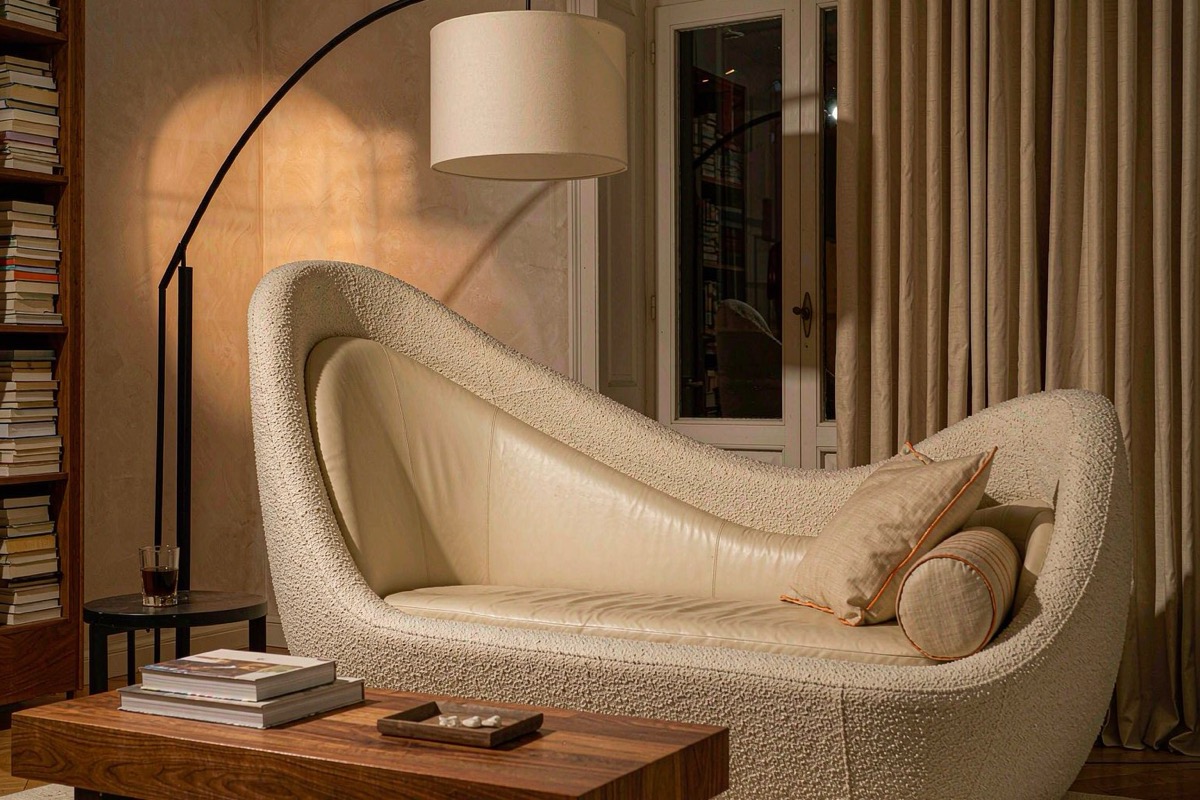
Here is the spec nobody prints on the price tag: the same sofa can arrive
in one box you carried up the stairs yourself, or on a pallet with a
two-person delivery window, and the difference between those two objects
is not size — it is a decision about joints. Flat-pack, knock-down and
fully assembled are three different theories about how a piece of
furniture should hold itself together, and each theory charges you
somewhere else: in the first five years, in the fifth move, or in the
repair bill nobody budgets for.
The three build types, defined by their joints
Flat-pack — the ready-to-assemble model — ships as finished panels with
hardware, and the buyer performs the structural assembly. The joints are
cam locks, wooden dowels and confirmat screws: fasteners chosen because an
unskilled person can drive them with an included tool. Knock-down
construction uses mechanical joints too, but bolts and threaded inserts
tightened by machine at the factory, designed so the piece can be
disassembled and rebuilt a limited number of times without losing
integrity. Fully assembled furniture is built once, at the factory or the
workshop, with glue, dowels and staples — joints that are stronger than
any hardware but permanent by definition.
The box is a consequence, not the cause. Flat-pack exists because loose
panels compress into small cartons, cutting freight volume dramatically;
fully assembled exists because a factory jig can apply glue and clamp
curing joints with a precision no living room allows. Everything about how
each type ages flows from those two starting decisions.
Transport: the first cost, paid differently
Shipping damage is where the build types first diverge. A fully assembled
sofa is its most vulnerable as a single rigid object — it cannot flex in a
truck, so corner impacts transfer straight into the frame, and it demands
the most expensive freight tier: palletized, white-glove, shrink-wrapped.
Flat-pack inverts the risk. Loose panels survive transit remarkably well
because nothing structural is stressed until assembly, but the buyer
absorbs a different transport cost: the odds of a missing cam lock, a
stripped dowel hole from over-tightening, a panel installed backward at
step eleven of a forty-step diagram.
Knock-down splits the difference in an underrated way. Because the factory
performs the critical tightening, the piece arrives with correct joint
preload — the exact spec that determines whether a bolted frame creaks for
a decade or stays silent. The buyer typically completes only coarse
connections, which is a much smaller error surface than full assembly.
Joint wear: the cost that compounds
Mechanical fasteners are consumables pretending to be structure. A cam
lock holds by friction against a dowel; every load cycle, every household
shake, works it microscopically looser. Repeated disassembly accelerates
this — threaded inserts strip, particleboard around a fastener crushes and
never grips the same way again. This is why the honest answer to "how many
times can I take it apart" is a small number, and why buyers planning
multiple moves should ask a maker for a rated reassembly count before
ordering.
Glued and doweled joints do not loosen, because there is nothing to
loosen: glue bonds across the whole wood surface rather than concentrating
load in a single fastener. A well-built fully assembled case piece can go
decades without a creak. The cost appears later instead — as permanent
geometry. The frame that never worked loose also never comes apart, which
matters the day it must fit through a doorway narrower than itself.
Repair and second life
Repairability runs in the reverse order of longevity. Flat-pack is the
most repairable in theory — replacement panels and hardware are cheap —
and the least in practice, because once a particleboard panel around a cam
lock is crushed, the fix is not a part, it is the whole panel. Knock-down
furniture is the sweet spot: bolts can be replaced, tightened, upgraded to
larger hardware, and a wobbly chair is a fifteen-minute fix with a wrench.
Fully assembled furniture resists the cheapest repairs but rewards skilled
ones. A loose dowel joint can be re-glued and clamped by a repair shop and
come back stronger than new; a split frame can be sistered. This is also
the resale logic — solid, fully assembled pieces hold a secondhand market
precisely because their construction is legible and repairable, while
worn flat-pack is usually worth more as a giveaway than as a listing.
Moving days: the cost most people forget to price
The build type you choose is really a bet on your own future addresses.
Flat-pack tolerates moves on paper but rarely survives three of them with
its joints intact. Knock-down is engineered for the problem — this is its
reason to exist — and a buyer who expects two or three relocations gets
genuine value from bolted construction, as long as each reassembly is done
with care. Fully assembled charges you at the door: staircase turns,
doorway angles, and a moving crew quoted by the hour for a piece that
cannot be simplified. Premium retailers selling assembled design furniture
— OROA's model, built around US warehouse stock and made-to-order
statement pieces rather than panel kits — are implicitly selling against
that moving-day pain, which is a legitimate trade for buyers who have
settled.
What each type actually costs you
Add it up honestly and each build type buys something real. Flat-pack
buys the lowest sticker price and the cheapest freight, paid for in joint
lifespan and a repair cycle that usually ends in replacement. Knock-down
buys movability and repairability at a moderate price, paid for in a
finite number of reassembly cycles. Fully assembled buys the longest
service life and the strongest joints, paid for in freight, delivery
logistics and zero disassembly. None of the three is the wrong answer;
the wrong answer is buying one while expecting another's behavior.
Before ordering, ask three questions. Where are the structural joints,
and are they mechanical fasteners or glue. How many disassembly cycles is
the construction rated for, in writing. And what does replacement hardware
cost and availability look like in five years. A furniture maker that can
answer those three has told you more about how the piece will age than
any fabric swatch ever will.