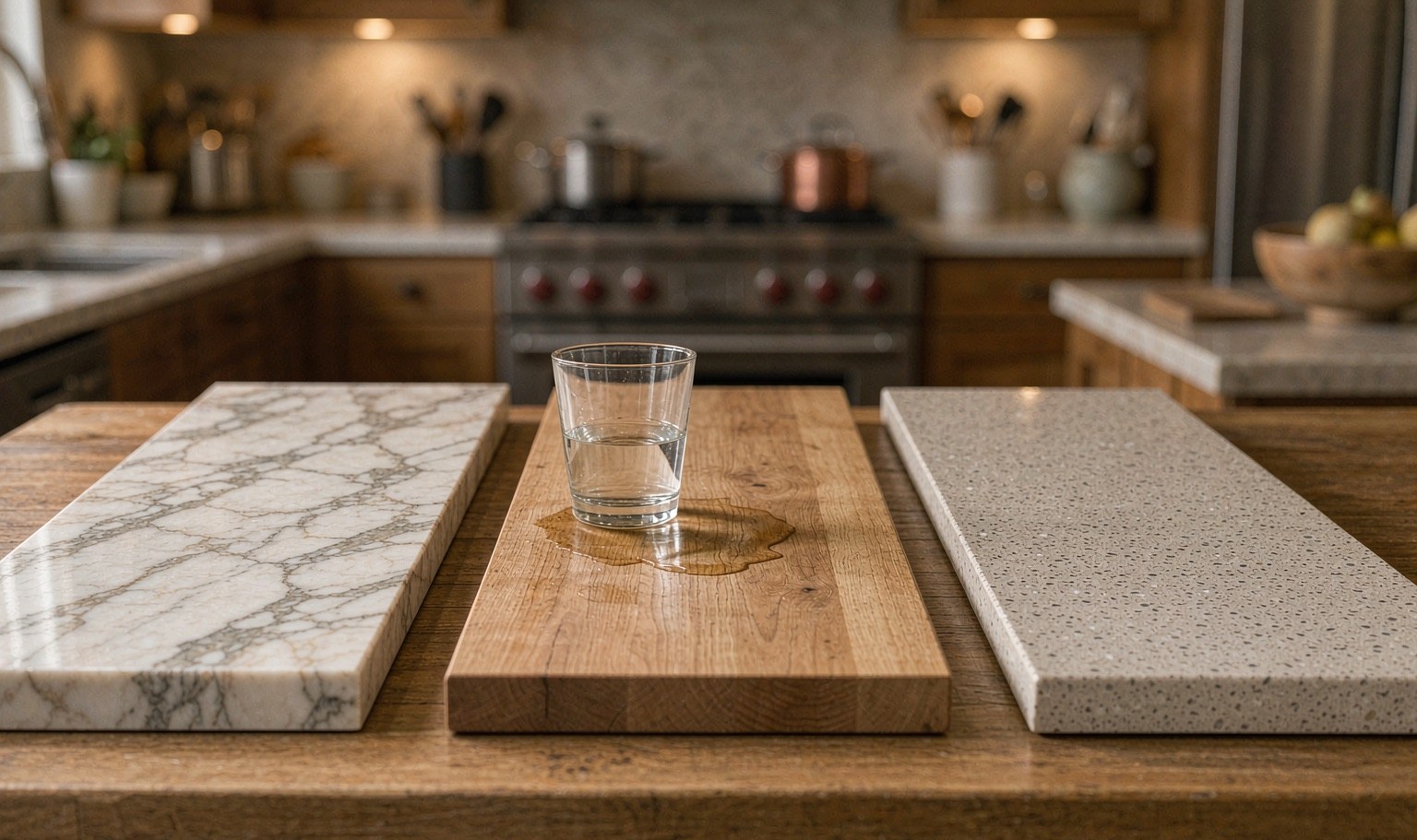
Countertops are sold in showrooms under conditions no kitchen ever
reproduces: no steam, no frying oil, no 12-inch cast iron straight off
the burner, no one leaning on the seam by the sink with a wet sponge.
Read the failure literature instead of the marketing, and a pattern
emerges fast: each material has one dominant way it breaks, everything
else is secondary, and the failure mode is almost never the one the
showroom conversation is about. What follows is aggregated from stone
fabrication and repair industry sources, manufacturer care documents,
and repair case reporting. No lab tests here; the goal is the consensus
picture of where each material actually breaks.
Engineered quartz: the resin is the weak point
Engineered quartz is roughly 90 to 95 percent quartz aggregate bound in
polyester or epoxy resin, and the mineral is nearly indestructible by
kitchen standards. The failure literature is unanimous on the point that
matters: virtually every real-world quartz failure traces to the resin,
not the stone. Repair-industry sources put the scorching threshold for
resin around 300°F, which a dry pan off the burner exceeds immediately.
The result is a permanent white, yellow, or brown mark that no cleaner
removes, and most manufacturers exclude heat damage from warranty
coverage. The second resin failure is UV: sustained direct sun through
an unshaded window photo-oxidizes the binder and yellows it, which is
why manufacturers uniformly restrict quartz to interior use. Chemical
attack rounds it out — undiluted bleach, oven cleaner, and solvents left
in contact can cloud or discolor the surface. Cracking shows up at sink
and cooktop cutouts, where corners concentrate stress. The counterweight:
quartz is non-porous, never needs sealing, and sealing it actually
backfires, leaving a hazy film. Its maintenance floor is the lowest of
any material here; its heat ceiling is the lowest too.
Who it suits: households that want near-zero maintenance and will
habitually use trivets; not the right pick for outdoor kitchens, sun
drenched counters, or cooks who park hot pans directly on the surface.
Granite: porous, and honest about it
Granite's failure mode is staining, and it is fully predictable. The
stone is porous to a degree that varies slab by slab; oil and colored
liquids wick into the pores and set, and lighter granites show it more.
The mitigation is a penetrating sealer, reapplied on a schedule the
surface itself dictates — the standard water-drop test is to place a
wet ring on the counter, and if the stone darkens within minutes the
sealer has worn through. Fabricators report that the yearly resealing
discipline is exactly the part homeowners skip, which is why stained
granite around cooktops and sinks is the most common repair call the
material generates. Chips occur at edges and cutouts, and cracked
granite usually traces to inadequate support or installation stress
rather than the stone itself. Unlike quartz, granite tolerates heat from
normal cooking without complaint.
Who it suits: cooks who want a heat-tolerant natural stone and will
accept one recurring maintenance task a year. If the sealing will never
happen, the failure is already scheduled.
Solid surface: scratches by design, sands back by design
Solid surface (the material category Corian anchors) fails softly, which
is its defining property. It scratches readily — cutting boards are not
optional — and it scorches under direct heat like any polymer. But the
same thermoset uniformity that makes it scratchable makes it repairable
in a way no other material here matches: scratches and scorch marks sand
out, chips fill with matching adhesive, and fabricated seams fuse into
something nearly invisible. Repair-industry sources treat damage that
would end a laminate top as a half-hour fix on solid surface. The
genuine structural failures are rare and mostly trace to cabinet
movement or impact near cutouts.
Who it suits: households that will actually cut on the counter
despite instructions, and rentals where damage repairability matters
more than prestige. The trade is a surface that looks slightly soft
under close inspection for one that never carries permanent scars for
long.
Tile: the field never fails, the grout does
Ceramic and porcelain tile counters fail at the joints. The tile itself
shrugs off heat, knives, and most chemicals; the grout lines are
porous, stain-holding, and crack with building movement, and a cracked
grout line over a particleboard deck admits water exactly where the
substrate is least able to take it. The surface geometry creates the
third failure that owners report most: an undulating, grouted plane is
harder to wipe clean than any continuous slab, and greasy grout holds
what the tile sheds. Industry repair sources treat regrouting and stain
management as the recurring cost of the material, effectively forever.
Who it suits: period kitchens where tile is the period-correct
choice, and budgets that favor material cost over labor. High-heat
resistance per dollar is genuinely the best in this comparison; daily
cleaning friction is the price.
Laminate: one seam, whole top
Laminate fails catastrophically from a small entry point. The decorative
layer is a melamine sheet bonded to a particleboard or MDF core, and the
core's structural story ends the day water crosses a seam — at the sink
rim, a mitered joint, or swollen edge banding. The particleboard swells,
and the swelling does not press back flat; Fine Homebuilding's repair
columnatists put it bluntly, that repairing swollen substrate costs more
than replacing the counter. Heat scorches the melamine surface, glue
failure lifts the sheet at edges, and deep burns or gouges generally
mean replacement of the surface. What laminate buys for all this is the
lowest installed cost in the comparison, by a wide margin, plus the
widest pattern selection.
Who it suits: rental units, first kitchens, and any situation where
the counter is consumption rather than investment. The discipline it
demands is one habit: never let water stand at a seam.
Butcher block: water and heat, applied honestly
Wood counters fail by staying wet. Water rings, darkened end-grain
around the sink, cracks from drying cycles, and burn marks from hot
pans are the documented failure set, and all of them arrive faster
around the sink and cooktop zones. The mitigations are the well-known
ones — regular oiling to keep the surface water-repellent, prompt
wiping, and food-safe finish renewal — and the material's compensating
virtue is unique in this list: surface damage sands out completely,
because the material is uniform wood for its full thickness. A butcher
block top can be re-sanded to factory condition decades in, which is a
reset no other material here offers.
Who it suits: dry zones — islands, baking stations, breakfast bars
— and owners who like a maintenance rhythm. Wood next to a sink is the
single highest-risk placement in the comparison.
The maintenance ledger, stated plainly
| Material | Dominant failure | Recurring maintenance | Damage reversibility |
| --- | --- | --- | --- |
| Engineered quartz | Heat/UV scorch of resin | None required; sealer actively harmful | Low |
| Granite | Staining through pores | Resealing, roughly yearly | Partial (poultice for stains) |
| Solid surface | Scratches, scorching | Occasional deep clean | High (sanding) |
| Tile | Grout staining and cracking | Grout sealing and cleaning | Low for cracked grout |
| Laminate | Core swelling at seams | None beyond seam vigilance | Near zero |
| Butcher block | Water damage, drying cracks | Oiling on a regular cycle | High (sanding) |
Read down the last column and the market logic becomes visible: the
materials people pay most for are the ones whose damage is hardest to
undo, and the cheapest materials are the most forgiving or the most
replaceable. Neither column is better. The match to make is between the
failure mode and the household's real habits, not its aspirations —
which is a criterion no showroom sample will ever display. For the
storage side of the same trade-off, see open shelving versus upper
cabinets; for the tools that
live on these surfaces, the rules change again, as covered in our
wooden cutting boards guide.