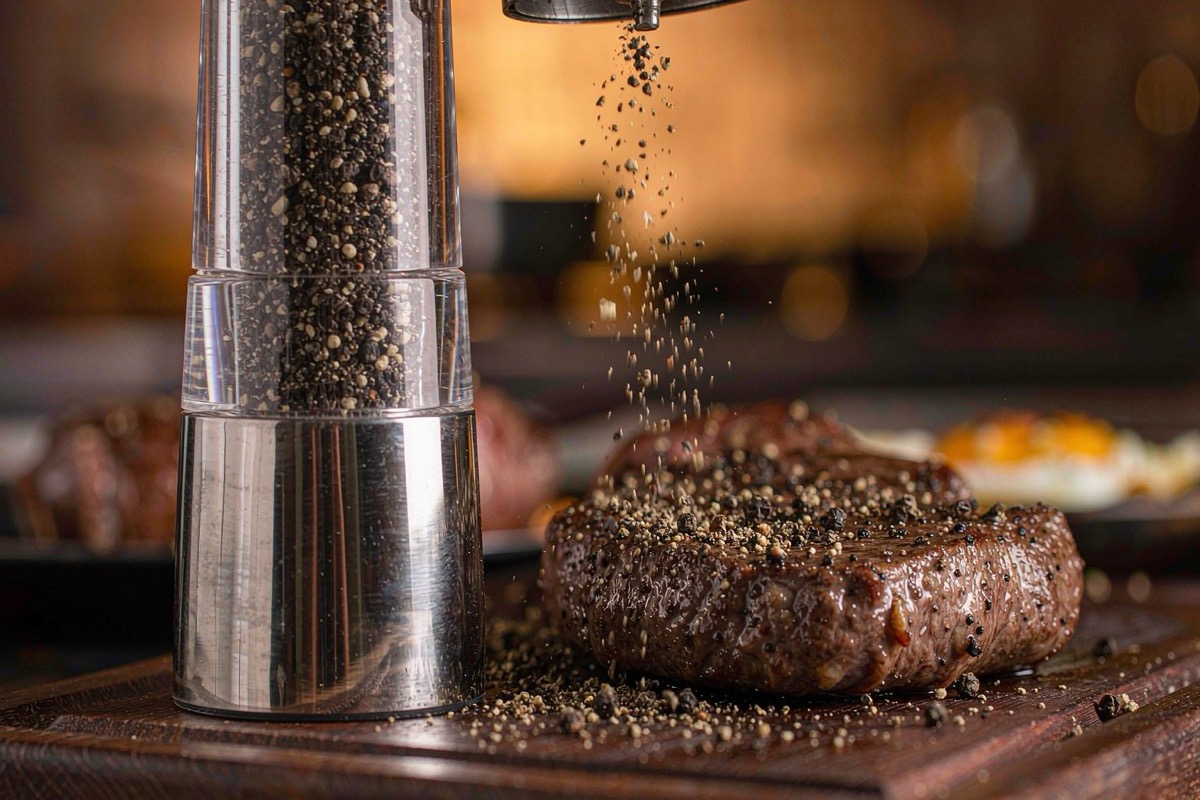
A pepper mill is the only kitchen tool most households own that is judged
entirely by how it feels in the hand and almost never by what it does to the
pepper. That is backwards. The difference between a good mill and a bad one
is measurable in particle size distribution, and once you understand what the
burr inside is actually doing, the entire category reorganizes itself: the
price stops being about finish and starts being about geometry.
What happens inside the mill
Every pepper mill works the same way in principle. Peppercorns fall into a
gap between two burrs — one fixed, one rotating — and the gap is narrow
enough that the corn cannot pass through whole. As it works through the gap,
it is fractured. What separates a precision mill from a supermarket twist
cap is how that fracture happens. A cheap mechanism crushes: the corn breaks
along whatever fault lines happen to exist, producing a wide spread of
particles — some dust, some shards, some chunks that survive nearly intact.
A burr designed with cutting faces strips the corn into layers instead,
producing a narrower distribution.
The word that matters is distribution. A handful of cracked pepper that
tastes flat usually is not under-seasoned; it is over-distributed. The dust
fraction releases its aroma in the first minute and then goes stale in the
air, while the chunk fraction never releases much at all. A narrow
distribution puts most of the particle mass in the size range that releases
aroma when it hits warm food. This is why a mill with a well-engineered
burr can make the same peppercorns taste louder without using more of them.
Ceramic versus steel: the actual trade-offs
The two standard burr materials each have a failure mode, and knowing yours
matters more than brand names.
Ceramic is harder than steel. It holds its cutting edge for years of
household use and it is completely corrosion-proof, which is why every salt
mill on the market uses a ceramic mechanism — saltwater attacks steel within
days. The weakness is brittleness. Ceramic burrs survive years of twisting
and die instantly on a tile floor. If your mill lives near the edge of a
counter and you have children, that is a real design constraint, not a
hypothetical one.
Hardened steel is tougher and machines to tighter tolerances, which is why
the high-precision pepper mechanisms use it. Steel burrs take and hold a
sharper cutting geometry than ceramic typically does, and they tolerate
being dropped. The weakness is corrosion: steel burrs and salt do not mix,
and even pepper holds a little surface moisture. A steel-burr mill that
gets left over a steaming pot will eventually show it. The care rules that
annoy people — dry storage, no dishwasher, damp cloth only — are not brand
fussiness; they are the maintenance schedule the material demands.
One more distinction that gets ignored: the burr does not work alone. The
drive shaft, the bearing surfaces and the spring that keeps the burr gap
from drifting under load are all part of the mechanism. On a cheap mill,
tolerance stacking means the gap you set is not the gap you get once the
corn is flowing. That is why a two-dollar mechanism cannot be fixed by
designing a better burr into it.
What the grind setting actually changes
Twisting the adjustment knob moves one burr closer to or farther from the
other. That is the entire mechanism — gap control. But what happens
downstream is more interesting than it sounds.
Set the gap fine and the corn fractures earlier and more completely: more
surface area, faster aroma release, and a faster fade. Fine grinds suit
sauces and dishes eaten immediately, where the volatile compounds have
seconds, not minutes, to reach your nose. Set it coarse and the particles
survive to the plate with their interior structure intact, releasing aroma
slowly as they sit on a warm steak. Coarse grinds are not "less flavor" —
they are slower flavor, which is why steakhouse service grinds at the table.
The setting that does almost nothing is the middle of the dial on a cheap
mill. If the mechanism cannot hold its gap under load — if the spring is
weak or the detents are vague — the settings smear into one another, and
"dial 4" means something different every time you fill the mill. A
click-stop mechanism exists to solve exactly this problem: each detent
corresponds to a known gap, so the grind is repeatable from fill to fill.
Six distinct, repeatable settings are worth more than thirty vague ones,
and this is the single easiest thing to test in a store. Set the mill
coarse, grind, set it fine, grind, and check that the two outputs actually
differ.
Refilling, feeding and the small design decisions
Top-load refilling — unscrew the knob, pour, reassemble — beats bottom-fill
cartridges on speed but exposes the mechanism to the kitchen. Bottom-fill
designs stay sealed but need a funnel and a steady hand. Neither is wrong;
what matters is whether the mill feeds reliably when it is half full,
because peppercorns that sit above the burr on a ledge of their own dust
produce the intermittent, stuttering grind that owners describe as
"uneven" in reviews. Gravity-fed hoppers with smooth walls feed better than
decorative ones with internal steps.
A worked example
Put a real product against this framework. Cole & Mason, a London company
founded in 1919 that has built mills since 1946, sells its flagship Derwent
with a "gourmet precision" mechanism — a design-registered burr pattern
meant to strip peppercorns into layers rather than crush them. That is the
distribution argument from above, expressed as a manufacturing claim, and
the owner record is unusually deep for the category: the Derwent holds a
4.6-star average across 12,478 Amazon ratings, with the praise
concentrating on exactly the things the mechanism predicts — grind
consistency and the positive click between settings. The same company's
salt mills use ceramic burrs for the corrosion reason above, and the
lifetime mechanism guarantee it attaches to the grinding part is essentially
a bet that hardened steel, kept dry, outlasts the body around it.
The example also shows where the premium stops compounding. Owners of that
same mill report that the acrylic body scratches under abrasive cleaning
and feels less substantial than the price implies — the mechanism is the
engineered part, and the housing is a commodity. That split is the pattern
across the whole category: the money is only rational where it touches the
burr.
What to check before you buy any mill
Three questions do most of the work. What is the burr material, and is the
mill dedicated to one spice — steel for pepper, ceramic for salt, no
exceptions? Is the adjustment detented, and does each stop produce an
output you can tell apart from the next? And can the mechanism be reached
for cleaning, or is it sealed into a body you can never dry properly?
Everything else — wood versus acrylic, weight, the shape of the knob — is
housing. Judge the burr by the numbers, and the housing by your kitchen.
The maintenance that decides longevity
Whatever mechanism you buy, three habits cover it. Keep it dry: humidity
stales pepper and corrodes steel, so never grind over a steaming pot. Clean
by grinding: a tablespoon of raw rice through the burr clears oils and dust
without water. And store it filled but capped — an open mill vents its own
aroma into the cupboard, which is aroma that never reaches the plate.