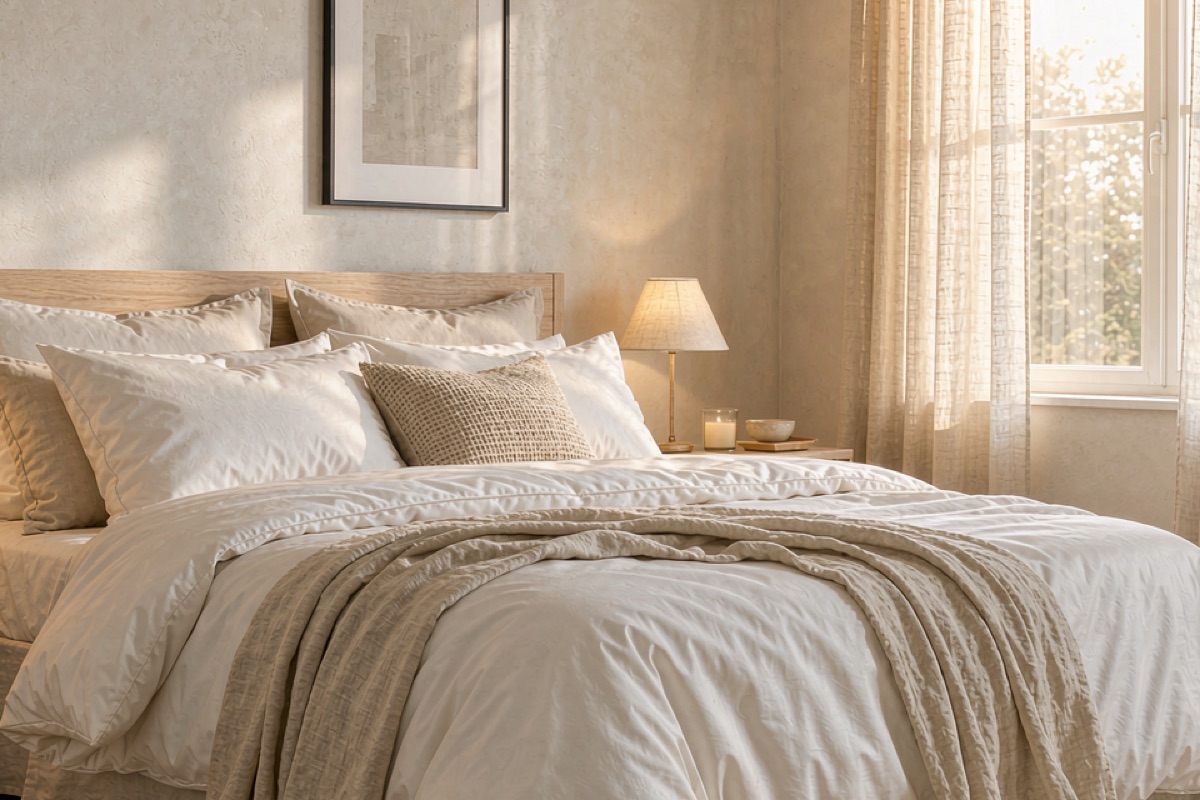
Sheets do not die dramatically. They thin along the wear line where your
shoulders rub the fabric night after night, they pill into a faintly rough
hand that no amount of softener hides, and the fitted sheet's corners
creep off the mattress until tucking them feels like rigging a sail. All
three failures are material science with a long fuse — cotton grade, yarn
construction and weave density predict them years in advance — and almost
none of that science appears on a bedding package. A useful cross-check is
the market's most visible sheet brand: Brooklinen's flagship Luxe Sateen
is a 480-thread-count, 100% long-staple cotton set that Good Housekeeping's
lab found strong and durable with minimal pilling after repeated
laundering, while the same brand's own guidance expects replacement around
the two-year mark. Both facts are true, and the physics explains why.
Staple length: the fiber determines the ceiling
Cotton is a hollow fiber a few centimeters long, and its length — staple —
is the master variable. Long-staple and extra-long-staple cottons (the
marketing names are Pima and Supima, Egyptian when genuinely sourced) spin
into yarns with fewer fiber ends exposed per inch. Pilling is a
fiber-ends problem: loose, short ends work out of the yarn under friction
and tangle into pills. A long-staple yarn is a yarn with nothing loose to
tangle, which is why the material itself is the first-order defense.
Combing adds a second filter, removing short fibers before spinning.
The Brooklinen flagship's spec sheet — long-staple cotton, woven in India,
OEKO-TEX certified — is the durability story in three words: long staple.
The counter-example is equally instructive. Amazon-side owner ratings for
the same Luxe line run around 4.0 stars, and the complaints that recur are
pilling and rips within months. Brand and material are identical in both
records; the difference is unit-to-unit variance, laundering habits and
friction environments (a rougher dryer cycle, a pet, body-care chemistry).
Long staple raises the ceiling, not the floor — it cannot rescue a hot
dryer and loose load.
Ply and thread count: how the number gets inflated
Ply is how many yarn strands are twisted into one thread, and it is where
thread-count marketing runs ahead of the engineering. A 300-count sheet
woven from single-ply long-staple yarn is dense and smooth; a 600-count
sheet is often the same fabric built from 2-ply yarns of shorter cotton,
counting each strand to double the number. Multi-ply yarns feel plush
because more surface hugs the hand — but every twist point is a fiber end
in waiting, and shorter staple means more of them. The inflated number
usually marks the weaker sheet, not the stronger one.
Thread count does carry real information at the low end: below roughly
200, fabric gets airy and wears thin early. Past 400-500 single-ply,
additional threads buy weight and heat, not lifespan. Denser is not
automatically tougher — a dense weave resists snagging but holds less
flexibility, so the fibers themselves do the abrading.
Weave density: sateen versus percale, the durability trade
Weave decides how the yarn wears. Sateen is a four-over-one pattern that
puts more thread face on the surface — it reads lustrous and silky, and
that exposed face is also the part that rubs. Percale's one-over-one plain
weave leaves less surface per yarn and feels crisp; it wrinkles more and,
in lab work, tends to score differently on strength. Neither weave is
fragile — both survive years in normal service — but they age along
different paths: sateen loses its sheen and smoothness first, percale
thins at the fold lines first. The instructive data
point is within one brand: Good Housekeeping's lab found lower
fabric-strength scores on Brooklinen's Classic Percale line than on the
sateen flagship, with visible wrinkles out of the dryer as the everyday
symptom. Plain weaves have their own virtue — they launder without drama
and resist snagging — but the point for a buyer is that weave and hand-feel
are inseparable from weave and wear, and "softest" and "toughest" are
never the same sheet.
The laundering half of the lifespan
Half of sheet durability happens in the laundry room, and the mechanisms
are mechanical, not mysterious. Heat relaxes and eventually embrittles
cotton fiber; a hot dryer is the single most aging step in the cycle. Wet
cotton is weaker than dry, so aggressive agitation on soaked fabric breaks
more fiber ends — the seeds of pilling. Hard water leaves mineral
deposits in the weave that stiffen it. And elastic, the fitted sheet's
narrowest margin, fatigues with heat and stretch, which is why the
oversize-cut fitted sheet with tab markers — the Luxe's "long side / short
side" labels are a fit feature as much as a convenience — ages more
gracefully than one cut exact. Cold wash, low tumble, skip the bleach:
that routine is worth more lifespan than any upgrade at checkout.
The owner record aggregates the same lesson. Long-term reports on the
Brooklinen line split between owners who get two comfortable years or more
under careful laundering and a minority describing thinning or tears after
a year — consistent with lab findings on the fabric itself and with the
brand's own two-year replacement expectation. Fabric sets the range;
maintenance picks the point within it.
Reading a sheet listing for durability
The durable sheet announces itself in the boring specs. Look for the
cotton's staple (long or extra-long, or a named variety), insist on
single-ply yarns, and treat anything above 500 threads per square inch as
a red flag rather than a resume. Check whether the weave is named — percale
for crisp resilience, sateen for a smoother hand with more surface wear —
and read the care line, because a brand confident in its fabric writes
cold-wash, low-heat instructions rather than hiding them. Two years of
comfortable service is a fair expectation for a well-built cotton set; the
specs above decide whether you land at the top of that range or buying
again in nine months.