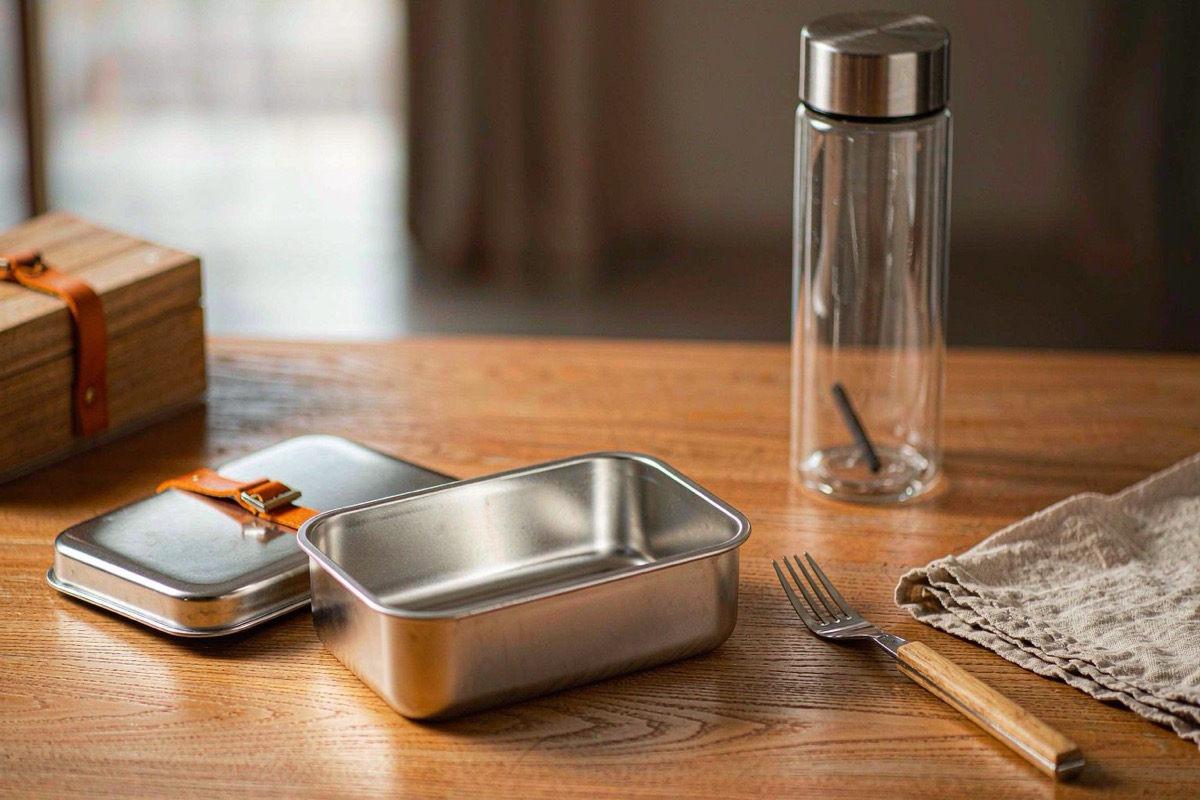
Every lunch box material is a bet about heat. Plastic bets you will
microwave and accepts a shorter service life; stainless steel bets you will
keep the box for a decade and accepts the thermos problem; bamboo bets on
an eco story and, in most products on the shelf, quietly involves a
plastic binder that the story omits. The materials tell you more about a
container than any brand page, and the labels underneath the materials
tell you more still. A good worked example sits on the premium end of the
market: Black+Blum, a London design studio whose stainless lunch box line
carries a lifetime guarantee, and whose choices illustrate what each
material buys and costs.
Stainless steel: the chemistry-proof option
Food-grade stainless — 18/8, also called 304, meaning roughly 18%
chromium and 8% nickel — is the least reactive material in common food
contact. It does not need a coating, does not absorb colors or odors, does
not leach anything when scratched, and shrugs off a decade of washing. That
is why the durability end of the lunch market converges on it: the
Black+Blum stainless box's lifetime guarantee is a materials claim as much
as a marketing one, and the same record shows what good sealing
engineering adds — a small silicone valve that lets the lid seat and then
pulls a vacuum as it locks, a seal Good Housekeeping UK's reviewer carried
through 100-plus commutes loaded with soup and dressed salads without a
leak.
The costs are equally physical. Metal reflects microwaves, so hot-lunch
eaters decant to a plate — Black+Blum's answer is the Lunch Pot, a two-part
design whose pot half is microwave-safe, holding a 4.7-star average across
20 owner reviews. Steel also transfers heat to the touch, dents if
mistreated, and costs more upfront — the price of a material that neither
stains chemically nor ages out of service. One honest caveat recurs in owner
feedback on the Lunch Pot: permanent staining from curries and goulash —
turmeric and paprika pigments cling to even the least reactive surfaces,
which tells you how aggressive those dyes are. Note what the staining is
not: it is pigment, not degradation. A stained steel pot is cosmetically
compromised and chemically untouched, which is the distinction plastic
cannot offer at any age.
Plastic: Tritan, polypropylene and the heat question
Plastic lunch boxes divide by polymer. Polypropylene (recycling code 5) is
the workhorse — cheap, dishwasher-safe, microwave-tolerant in food-grade
formulations. Tritan is a copolyester marketed heavily as BPA-free, and it
is the material in Black+Blum's Eau Good bottle (4.2 stars across 1,598
Amazon-linked ratings), where clarity and toughness matter for a water
bottle.
The heat question is where plastic earns its reputation. All plastics
migrate small amounts of their constituents into food, and migration
increases with temperature, contact time and fat content. That is not an
accusation — it is the reason food-contact plastics are regulated — but it
is the reason the same container is safe for cold pasta salad and
questionable for reheating curry. A scratched, clouded, heat-cycled plastic
box has migrated most of what it was ever going to; the practical lifespan
of a plastic lunch box is measured in years, not decades, and replacement
is a feature of the material, not a defect of your brand.
Bamboo: the label that usually means melamine
The bamboo category deserves the most skepticism per word of marketing.
Genuine, unmodified bamboo is a hard grass, awkward to seal and rarely used
alone for lunch boxes. What sells as "bamboo fiber" tableware is almost
always bamboo powder bound in melamine resin — and melamine is the
problem. Food-safety regulators, the FDA included, advise against heating
melamine-ware because heat increases migration of melamine and
formaldehyde into food, especially acidic food. So a bamboo lunch box is,
materially, a plastic box with a plant-fiber filler and a better story.
Some makers now sell melamine-free bound-bamboo with polypropylene binders,
which resolves the heat concern; the phrase to look for is what the binder
is, not what the fiber is.
Reading the labels: what each one certifies
The safety marks under the materials are worth learning once, because they
answer different questions:
- BPA-free — states the absence of one specific compound (bisphenol A)
and nothing else. It became a marketing badge after the concern went
mainstream; it is not a general safety certificate.
- FDA food-contact compliant — the material formulation has been
evaluated under US rules for contact with food. The baseline for anything
sold in the US.
- LFGB — the German food-contact framework, which tests a broader set
of substances than FDA rules and, unlike the FDA approach, rejects
materials that transfer any detectable taste or odor. On a lunch box
sold across markets, LFGB compliance is the stronger of the two paper
claims.
- Prop 65 warnings — California's right-to-know list, not a ban; a
warning flags a listed substance above a threshold, and the dose and
context are the reader's to judge.
- Oeko-Tex Standard 100 — an excellent textile certification that
appears on lunch bags and fabric components; it certifies textiles, not
food-contact plastics, so it answers a different question than the ones
above.
Matching material to job
The decision reduces to the lunch, not the logo. Reheating at work twice a
week argues for polypropylene or a microwave-safe partitioned design, used
cold-side mostly and replaced as it wears. A decade of commute salads and
dry lunches argues for 18/8 stainless with engineered sealing — the
Black+Blum pattern, where the lifetime guarantee and the vacuum-valve lid
make sense only because the base material outlasts everything attached to
it. Hot soups in winter are a thermos argument regardless of box material.
And bamboo, in most of what the shelf offers, should be chosen knowing the
binder — fine for cold, dry foods, out of the microwave on principle. The
materials are honest even when the marketing is not; read the polymer, the
binder and the certification together, and the label noise sorts itself
out.