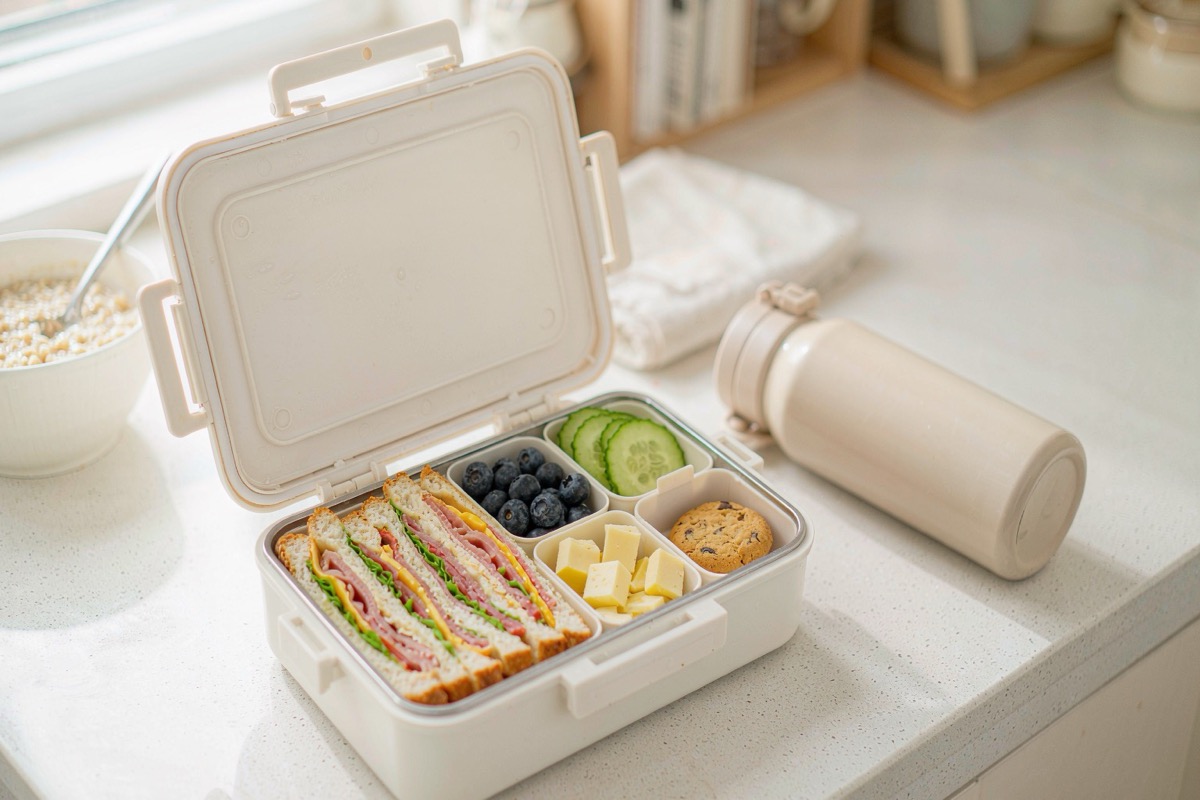
A lunch box survives a flat ride on a kitchen counter and fails on a school
bus, and the difference is not luck — it is physics. Leaks happen where the
seal lets them, and the seal is a system: a silicone gasket, a set of
latches that compress it, and a shell rigid enough to hold both in
alignment. Every one-star review of a bento box is, at some level, a report
about one of those three links. The category's best-seller, the Bentgo Kids
line with its 4.7-star average across more than 35,850 Amazon ratings, is a
useful anatomy lesson here, because its design decisions are legible and
its failure modes — read from owner reports — map exactly onto the physics.
The gasket: where the seal actually lives
The working part of any leak-proof box is the gasket: a continuous loop of
silicone, usually seated in a groove in the lid, that fills the microscopic
gap between two flat surfaces. Silicone earns the job for three reasons.
It is soft enough to deform and fill irregularities. It springs back
thousands of times without taking a set. And it is chemically inert against
tomato acid, oil and salt — the three things in a lunch that attack lesser
rubbers.
The design detail that separates real seals from marketing ones is
continuity. In a multi-compartment box like the Bentgo Kids — five fixed
compartments totaling 2.4 cups — the gasket must run around the outside of
the tray and bridge between each divider, so that one wall's seal cannot
bypass another. Where manufacturers cheap out is exactly at those divider
crossings, and that is where yogurt ends up in the crackers. Owner
consensus on the Bentgo Kids reads like a controlled test of the concept:
yogurt and dressing stay put, commute after commute, which says the
gasket-and-divider geometry is continuous and well seated. The same owner
record shows the maintenance requirement the physics demands: the gasket
must be dry when the box closes. A damp gasket in a closed box is a mold
incubator, and dried-on residue under the seal breaks the compression
surface — the two most common causes of a "suddenly leaky" box that is
actually a dirty one.
The latches: clamping force and its slow decay
A gasket does nothing by itself; it is a passive lump of rubber until
something presses it. That is the latches' job, and the engineering
language for it is clamping force — enough pressure, evenly distributed
along the seal line, to close every gap. Latch design is a compromise: a
four-year-old has to open it independently, which sets an upper bound on
how stiff it can be, while a backpack tumbling off a bench sets a lower
bound on how firmly it holds. The Bentgo Kids' two side latches are sized
to that compromise — owner reviews describe kids operating them by day two
of school.
Latches are also where bento boxes die of old age. Plastic hinge and snap
features fatigue with every cycle, and by year three or four of daily
school service the clamping force fades, the gasket seats unevenly, and the
box that was leak-proof in September weeps in March. Most owners reporting
worn latches on the Bentgo line had them replaced under the 2-year
warranty, which is the warranty working as designed — but the physics
explains why no plastic lunch box is a forever purchase.
The shell: warp is a seal killer
The third component is the one nobody thinks about until it fails. A gasket
can only seal against a surface that is flat and true, so the shell —
which is plastic in nearly every bento box — is part of the sealing system.
Heat is its enemy. A polypropylene shell run through a dishwasher's drying
cycle can warp a fraction of a degree, and a fraction is enough: the gasket
now bridges a gap at one corner instead of pressing it shut, and the leak
returns with the box looking perfectly normal. This is why the care rules
on the Bentgo boxes read the way they do — the removable tray is
dishwasher-safe, but the outer shell is hand-wash only — and why the
owner-record pattern is so consistent: dishwasher-warped shells and moldy
damp-sealed gaskets explain nearly every leak complaint in the one-star
file. The design could be more forgiving; the physics is not negotiable.
The food side: viscosity beats volume
The last variable is the cargo. Liquids fail seals in proportion to how
thin they are and how hard they are shaken. At rest, water in a sealed
tray exerts modest, steady hydrostatic pressure that a good gasket shrugs
off. In motion — the backpack swing, the bus ride — the liquid sloshes in
pulses, hammering the weakest point of the seal hundreds of times a trip.
Viscosity is the defense: yogurt, hummus, dressing and cut fruit resist
sloshing, which is why owner reports of the sealed compartments succeeding
cluster on exactly those foods. Soup-grade liquids are a thermos job, and
the Bentgo Modern's owner record states the same boundary honestly — its
5.5-cup capacity and removable divider handle adult portions with a seal
that is leak-resistant rather than leak-proof, a 4.2-star rating that
mostly documents thin liquids escaping while everything else stays
contained. Temperature adds the last constraint: the Chill variant slots an
integrated ice pack under the tray — 4.6 stars across 19,013 ratings —
because cold retention and leak containment are separate problems solved by
separate hardware.
Read together, the pieces form a checklist that outlives any brand: a
continuous gasket that bridges every divider, latches with real clamping
force, a shell you keep out of heat, and food matched to the physics. Test
any box before trusting it — fill the thinnest-liquid compartment, close it
firmly, shake it over a sink — and the verdict takes thirty seconds. A box
that passes all four conditions stays dry for years. A box that fails one
of them will eventually leak, no matter what the packaging says.